• Abraham Lincoln for President, White House Collection
    Unknown
    campaign
    White House Collection
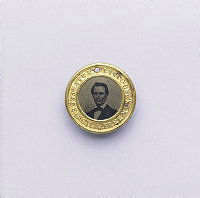
    This is a campaign button from Abraham Lincoln's 1860 bid for president. The button reads "Abraham Lincoln Free Soil & Free Men." He was elected and began his tenure as president in 1861. This was one of the earliest examples of a campaign button using a photograph.
  • Abraham Lincoln, White House Collection
    Gutzon Borglum
    sculpture
    likeness
    busts
    White House Collection
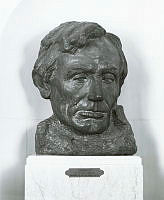
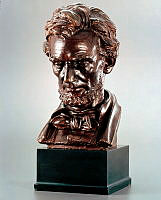
    This bronze bust of President Abraham Lincoln was created by American sculptor Gutzon Borglum, formally known as John Gutzon de la Mothe Borglum, in 1908. The large bust is installed atop a tall, white, stone pillar and has historically been displayed in a niche in the East Garden Room, visible to public visitors and guests as they enter the White House through the East Wing. Borglum was also famous for his work on Stone Mountain and Mount Rushmore.
  • President Lincoln and His Cabinet in Council at the White House, White House Collection
    Frank Leslie's Illustrated Newspaper
    Cabinet
    White House Collection
    engravings
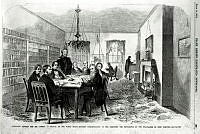
    This wood engraving print of President Abraham Lincoln meeting with his Cabinet was published in "Frank Leslie's Illustrated Newspaper" on March 30, 1861. The purpose of the Cabinet meeting, just weeks into President Lincoln's first administration, was to evaluate the developing situation at Fort Sumter in Charleston, South Carolina. Fort Sumter would be the location of the first shots of the American Civil War and play an important role in the prolonged Union siege of Charleston.
  • The Lincoln Family, White House Collection
    Thomas Kelly
    First Family
    White House Collection
    painting
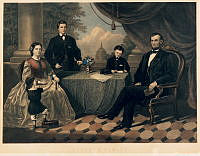
    This lithograph print of the Lincoln family was made by Thomas Kelly of New York. Prints of President Lincoln and his family were popular during his administration, in particular this color lithograph, which has hung in the Lincoln Sitting Room in the past. Featured in the lithograph are President Lincoln and First Lady Mary Todd Lincoln and three of their sons, (from left to right) Tad, Robert, and Willie.
  • President Lincoln's Last Sitting, White House Collection
    Alexander Gardner
    portrait
    White House Collection
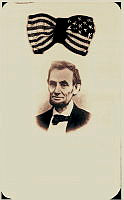
    This retouched portrait photograph of President Abraham Lincoln was taken by Alexander Gardner. The original photograph was taken on February 5, 1865 and is believed to be the last sitting President Lincoln had with Gardner, who had accumulated a large portfolio of images of Lincoln over the years. The addition of the ribbon and the retouched border suggests this reproduction was made after President Lincoln's death on April 15, 1865.
  • Tad Lincoln Reads with His Father, White House Collection
    F. B. Carpenter
    First Family
    White House Collection
    painting
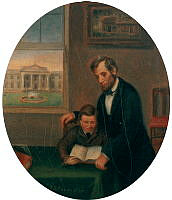
    This miniature painting of President Abraham Lincoln was made by New York artist Francis Bicknell Carpenter, better known as F. B. Carpenter, between 1873 to 1874. In the painting, Lincoln looks over the shoulder of his youngest son, Tad Lincoln, in a concerning manner. The White House is visible through a window in the background and President Lincoln's childhood in Kentucky is represented with a painting of a log cabin hanging on the wall. Carpenter had previously painted Lincoln for his depiction of the first reading of the Emancipation Proclamation, which is also in the White House Collection. For the painting, Carpenter worked off of portrait photographs taken at Mathew Brady's studio and in the White House. Included in that series of photographs was one of President Lincoln and Tad taken on February 9, 1864 and served as the basis for this painting.
  • Abraham Lincoln, White House Collection
    Mathew Brady
    portrait
    White House Collection
    painting
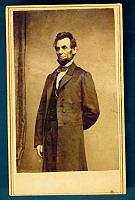
    This portrait photograph of President Abraham Lincoln was taken by Mathew Brady on January 8, 1864 at his studio in Washington, D.C. Brady photographed all the members of the Lincoln family, with this particular photograph from a series of five poses taken of President Lincoln. The original photograph was a carte de visite print with Brady's logo printed on the reverse side.
  • Abraham Lincoln, White House Collection
    Augustus Saint-Gaudens
    busts
    sculpture
    likeness
    White House Collection
    This bronze bust of Abraham Lincoln, who was president from March 4, 1861 until his assassination on April 15, 1865, was created in the late nineteenth century by Augustus Saint-Gaudens. After Lincoln's assassination, the accomplished sculptor became one of many artists commissioned to create memorial portraits of the President. This bust is a replica of the full-size standing statue that Saint-Gaudens sculpted for Lincoln Park in Chicago, Illinois. Saint-Gaudens experimented with many stances and expressions before deciding to portray a pensive Lincoln. It was acquired for the White House Collection by the White House Historical Association in 1975.
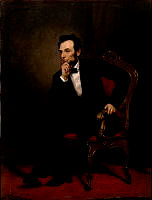
  • Abraham Lincoln by George Peter Alexander Healy (1813-1894), White House Collection
    G. P. A. Healy
    portrait
    official portrait
    White House Collection
    painting
    This portrait of President Abraham Lincoln was created by George Peter Alexander Healy (sometimes known as G. P. A. Healy) in 1869, after Lincoln's death on April 15, 1865. Lincoln originally sat for Healy in 1864, and the artist depicted Lincoln in this pose in his painting, The Peacemakers, an 1868 work that showed Lincoln conferring with Union military leaders during the final days of the Civil War. After Lincoln's death, Healy realized that the depiction made an impressive portrait of Lincoln alone and painted three replicas, one of which became part of the White House Collection. Lincoln became president on March 4, 1861, and served in the House of Representatives earlier in his life.
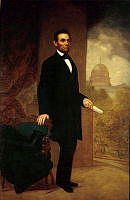
  • Lincoln, the Ever-Sympathetic, White House Collection
    Stephen Arnold Douglas Volk
    portraits
    White House Collection
    painting
    This portrait of Abraham Lincoln, who was president from March 4, 1861 until his assassination on April 15, 1865, was painted by Stephen Arnold Douglas Volk in 1931. Volk's father, Leonard Volk, created a life mask of then presidential candidate Lincoln in 1860, and the younger Volk used the mask to create several posthumous portraits of Lincoln. The image later hung in the Lincoln Bedroom at the White House.
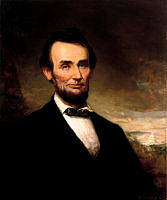
  • Abraham Lincoln, White House Collection
    George Henry Story
    portrait
    White House Collection
    painting
    This portrait of Abraham Lincoln, who was president from March 4, 1861 until his assassination on April 15, 1865, was painted by George Henry Story circa 1915. A renowned portraitist and genre scene painter, Story received a commission to paint Lincoln's portrait in 1862. Story observed Lincoln on several occasions, making notes and sketches in pencil that he later used to paint the president's likeness. Lincoln had served in the House of Representatives earlier in his life.
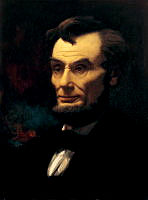
  • Abraham Lincoln, White House Collection
    William F. Cogswell
    portrait
    White House Collection
    painting
    This portrait of Abraham Lincoln, who was president from March 4, 1861 until his assassination on April 15, 1865, was painted by William F. Cogswell in 1869. The self-taught artist worked at a paint factory in Buffalo, New York before earning a reputation as a skilled portraitist. Cogswell is best known for his portraits of Lincoln and Ulysses S. Grant. Lincoln had served in the House of Representatives earlier in his life.
  • Abraham Lincoln, White House Collection
    Unknown
    busts
    sculpture
    likeness
    White House Collection
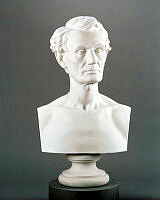
    This unglazed porcelain bust of Abraham Lincoln, who was president from March 4, 1861 until his assassination on April 15, 1865, was created by the National Porcelain Factory of Sèvres in 1909. The bust is based on a life mask of Lincoln that sculptor Leonard Volk created in 1860, when Lincoln, then a presidential candidate and lawyer, was in Chicago to argue a court case. Volk used the mask to create a life-size statue of Lincoln for the Illinois State Capitol in Springfield.
  • The Republican Court in the Days of Lincoln, White House Collection
    Peter Frederick Rothermel
    receptions
    painting
    inaugurations
    State Floor
    East Room
    Cabinet
    White House Collection
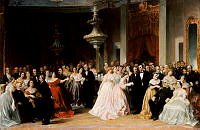
    This painting by Peter Frederick Rothermel depicts a fictitious formal reception in the East Room of the White House following President Abraham Lincoln's second inauguration on March 4, 1865. The painting features a number of historical figures: President Abraham Lincoln (standing to the right of the large chandelier that intersects the middle of the painting) with General Ulysses S. Grant to Lincoln's right, presenting his wife, Julia Dent Grant, to the president (in a light pink gown, shaking hands with Lincoln). First Lady Mary Todd Lincoln stands to Lincoln's left, holding a fan to the shoulder of General Winfield Scott. To the left of the chandelier, orator Edward Everett (who died in January 1865, before the scene portrayed this painting purportedly took place) is seated, and Secretary of State William H. Seward and General William Tecumseh Sherman are standing (Sherman stands between the two men, but toward the back). Rothermel was an American painter who is mostly known for his large historical paintings.
  • The Peacemakers by George Peter Alexander Healy (1813-1894), White House Collection
    G. P. A. Healy
    transportation
    military
    meetings
    Virginia
    Civil War
    White House Collection
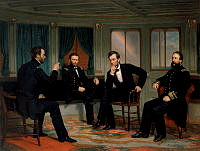
    This painting by George Peter Alexander Healy depicts a meeting late in the Civil War. In the cabin of the steamer The River Queen are seated (from left to right) Major General William T. Sherman, Lieutenant General Ulysses S. Grant, President Abraham Lincoln, and Rear Admiral David D. Porter. The meeting took place in March 1865 on the James River in City Point, Virginia, less than a week before the fall of Petersburg, Virginia. According to Porter, the discussion flowed mostly between Lincoln and Sherman, which is reflected in all four subjects' body languages. Sherman previously sat for a portrait by Healy and commissioned the artist to paint the meeting, providing him with first-hand accounts by himself and Porter as well as a diagram of the cabin. Born in Boston, Massachussetts, Healy was a popular portrait painter who sketched and painted Lincoln multiple times during his presidency.
  • Grand Reception at the White House, January 1862, White House Collection
    Alfred R. Waud
    receptions
    military
    engraving
    State Floor
    New Year's
    Cabinet
    Blue Room
    White House Collection
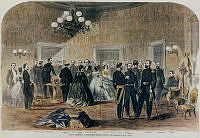
    This hand-colored wood engraving by Alfred R. Waud appeared in the centerfold of Harper's Weekly on January 25, 1862. Waud made a sketch in person at the reception, which was the basis for the engraving. Abraham Lincoln, tallest man present, welcomes guests near a White House doorway during a Grand Reception in January 1862. Secretary of the Treasury Salmon P. Chase and his daughter Kate greet Mrs. Lincoln, while several Union Army officers fill out the scene.