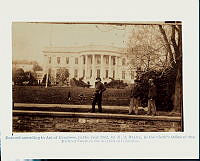
• Soldiers on the South Wall, White House Collection
    Mathew Brady
    White House
    Civil War
    south view
    White House Collection
    This photograph of soldiers on the South Lawn of the White House was taken by Mathew Brady in 1862, during Abraham Lincoln's presidency. Brady was one of the first professional photographers in the United States. He studied under inventor Samuel B. Morse, who brought the daguerreotype from France to America. Brady achieved his fame documenting the Civil War. This photograph was printed as a carte de visite, popular Victorian collectables between 1859 and the 1870s. Much like modern trading cards, cartes de visite were exchanged between family and friends and displayed in albums.
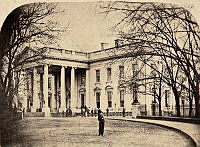
  • North Front of the White House, White House Collection
    Henry F. Warren
    White House
    Civil War
    children
    north view
    White House Collection
    This black and white photograph of the North Portico is attributed to Henry F. Warren. The boy in the foreground is thought to be Tad Lincoln, Abraham Lincoln's younger son.
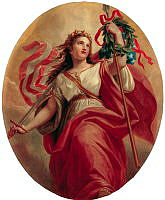
  • Liberty, White House Collection
    painting
    Civil War
    White House Collection
    The painting of the allegorical representation of Liberty, along with its companion piece Union, is by Italian-born artist Constantino Brumidi. After Brumidi completed The Apotheosis of Washington in the United States Capitol Rotunda in 1866, President Ulysses S. Grant commissioned the artist to create two paintings for display in the renovated Entrance Hall of the White House. Both were mounted in the ceiling and represent the post-Civil War resurgence and indivisibility of the Union. After being removed during the Benjamin Harrison administration, they were returned to the White House following rediscovery in 1978. Brumidi would continue his work in the Capitol until his death in 1880.
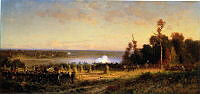
  • Cannonading on the Potomac, October, 1861, White House Collection
    painting
    landscapes
    Virginia
    Maryland
    Civil War
    White House Collection
    This landscape is by Alfred Wordsworth Thompson, an artist who captured American Civil War battle scenes for publications such as Harper's Weekly and the Illustrated London News. Thompson composed both engraved illustrations and paintings. This particular painting depicts the October 20, 1861 cannon fire across the Potomac River near Ball's Bluff and Leesburg in Virginia and Harrison Island and Edwards Ferry in Maryland that was a precursor to the Battle of Ball's Bluff on October 21st.

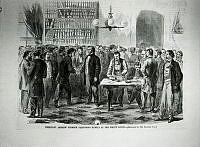
  • President Andrew Johnson Pardoning Rebels at the White House, White House Collection
    Harper's Weekly
    military
    Civil War
    White House Collection
    This wood engraving was published in "Harper's Weekly" of President Andrew Johnson pardoning former Confederates at the White House. Johnson's decision to pardon Confederate rebels came in May 1865, shortly before his plan for Reconstruction policies in the United States. While there were exemptions to the proclamation, these pardons were generally for any Confederates who had not held office during the war, had not ascended above the rank of colonel in the army or lieutenant in the navy, and owned less than $20,000 worth of property. This policy upset many Republicans who believed that Johnson was far too lenient on the South for its rebellion against the federal government.
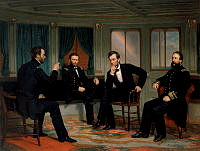
  • The Peacemakers by George Peter Alexander Healy (1813-1894), White House Collection
    G. P. A. Healy
    transportation
    military
    meetings
    Virginia
    Civil War
    White House Collection
    This painting by George Peter Alexander Healy depicts a meeting late in the Civil War. In the cabin of the steamer The River Queen are seated (from left to right) Major General William T. Sherman, Lieutenant General Ulysses S. Grant, President Abraham Lincoln, and Rear Admiral David D. Porter. The meeting took place in March 1865 on the James River in City Point, Virginia, less than a week before the fall of Petersburg, Virginia. According to Porter, the discussion flowed mostly between Lincoln and Sherman, which is reflected in all four subjects' body languages. Sherman previously sat for a portrait by Healy and commissioned the artist to paint the meeting, providing him with first-hand accounts by himself and Porter as well as a diagram of the cabin. Born in Boston, Massachussetts, Healy was a popular portrait painter who sketched and painted Lincoln multiple times during his presidency.
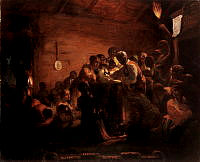
  • Watch Meeting - Dec. 31st 1862 - Waiting for the Hour by William Tolman Carlton (1816-1888), White House Collection
    W. T. Carlton
    slavery
    painting
    Emancipation Proclamation
    Civil War
    White House Collection
    This painting by W.T. Carlton, also known as William Tolman Carlton, captures the moments before the Emancipation Proclamation took effect at midnight on Thursday, January 1, 1863. A group of enslaved people surrounds a crate with an older man at the center holding a large pocket watch as the group counts down the remaining time until New Year's Day. The crowd of figures is illuminated only by a torch at the right edge of the canvas, beside which is a print of the Emancipation Proclamation posted to the wall. At left is a doorway, beyond which is an illuminated cross and, in the doorway, stands the silhouette of a figure holding the Union flag. There is one white woman present, sitting left of the center, looking toward the black woman beside her. Across the bottom, Carlton has inscribed the title of the painting on connecting links of a chain. The original painting was a gift to President Abraham Lincoln in July 1864 and left the White House with First Lady Mary Lincoln after his assassination. Its whereabouts are now unknown. The current version in the White House Collection is likely Carlton's first study and is not signed or dated. It was acquired during the Richard M. Nixon administration. Carlton was born in Boston and spent much of his life in Dorchester, Massachusetts.
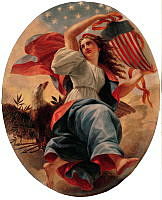
  • Union, White House Collection
    Constantino Brumidi
    painting
    Civil War
    White House Collection
    This painting, along with its companion piece Liberty, is by Italian-born artist Constantino Brumidi. After Brumidi completed The Apotheosis of Washington in the United States Capitol Rotunda in 1866, President Ulysses S. Grant commissioned the artist to create two paintings for display in the renovated Entrance Hall of the White House. Both were mounted in the ceiling and represent the post-Civil War resurgence and indivisibility of the Union. After being removed during the Benjamin Harrison administration, they were returned to the White House following rediscovery in 1978. Brumidi would continue his work in the Capitol until his death in 1880.