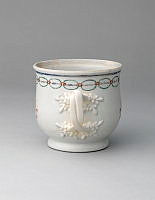
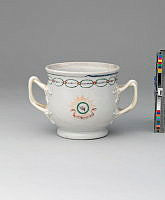
• Sugar Bowl, Washington State Service, White House Collection
    Unknown
    tableware
    serveware
    State Service
    tea services
    This sugar bowl was produced in 1795 and presented to First Lady Martha Washington in 1796 by a director of the Dutch East India Company. The bowl was part of a Chinese Export porcelain service and originally had a lid. It was decorated with her initials and a border of chain links representing the 15 states of the Union, the service was used in the Washingtons' Philadelphia residence. As a result of increased sugar production due to growth of sugar plantations fueled by the Atlantic slave trade, sugar bowls became popular pieces of tableware. The Washingtons may have displayed it in public spaces alongside other fine tableware, exhibiting their wealth, worldliness, and patriotism to guests dining at their home.

  • Sugar Bowl, Washington State Service, White House Collection
    Unknown
    tableware
    serveware
    State Service
    tea services
    This sugar bowl was produced in 1795 and presented to First Lady Martha Washington in 1796 by a director of the Dutch East India Company. The bowl was part of a Chinese Export porcelain service and originally had a lid. It was decorated with her initials and a border of chain links representing the 15 states of the Union, the service was used in the Washingtons' Philadelphia residence. As a result of increased sugar production due to growth of sugar plantations fueled by the Atlantic slave trade, sugar bowls became popular pieces of tableware. The Washingtons may have displayed it in public spaces alongside other fine tableware, exhibiting their wealth, worldliness, and patriotism to guests dining at their home.
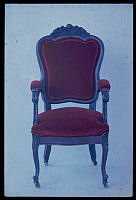
  • Rococo-Revival Armchair, White House Collection
    Unknown
    seats
    furniture
    furnishings
    White House Collection
    This Rococo-Revival armchair was taken by George F. Mobley in 1962. It is similar to the one in G. P. A. Healy's famous portrait of President Abraham Lincoln. The chair was found in storage and reupholstered in wine-red velvet that was popular in the Victorian era. White House Curator Lorraine Waxman Pearce was most likely responsible for researching and arranging for the chair's restoration. This photograph is part of the Lorraine Waxman Pearce Collection. Lorraine Waxman Pearce served as the first White House Curator from 1961 to 1962. As curator, she oversaw refurbishment projects, implemented collections policies, and collaborated with First Lady Jacqueline Kennedy to write the first White House guidebook—a joint publication of the National Geographic Society and the White House Historical Association. Since its original publication in 1962, “The White House: An Historic Guide” has been revised, updated, and printed for over 60 years.