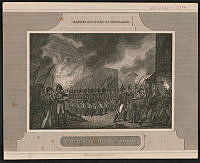
• Capture of the City of Washington
    J. & J. Cundee
    War of 1812
    Washington, D.C.
    engraving
    military
    This engraving of the capture of Washington, D.C. during the War of 1812 was created by London printers J and J Cundee in 1815 and used as an illustration in an edition of Paul Rapin's multi-volume "History of England." British troops entered and burned the capital, including the White House, on August 24, 1814. Though British forces occupied the city for only a short time, they inflicted serious damage. President James Madison escaped the White House before the attack, but finished out his second term in the nearby Octagon House and a row house in "Six Buildings" complex on Pennsylvania while the White House was rebuilt.
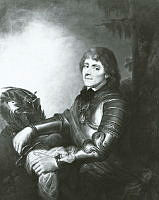
  • Tadeusz Kosciuszko, White House Collection
    portraits
    military
    likeness
    American Revolution
    White House Collection
    This copy of a portrait of Tadeusz Kosciuszko was done by Danute Sawnor, based on the original portrait by Jozef Grassi. Kosciuszko was a Polish military leader who fought in the American Revolution. Kosciuszko is depicted wearing the insignia of the Order of Cincinnati, an exclusive society of military officers formed during the Revolutionary era.
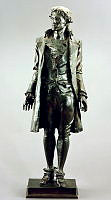
  • Nathan Hale
    sculpture
    military
    American Revolution
    White House Collection
    A small bronze statue of Continental Army solider Nathan Hale by sculptor Frederick William MacMonnies and from founder H. Rouard. This is a smaller version of the life-sized statue of Hale which is in New York City. The 21-year old Hale was captured by the British military while on an intelligence-gathering mission in New York City and executed in September 1776. His last words - "I only regret that I have but one life to lose for my country" - solidified his status as an American hero. The statue shows Hale standing upright with palms facing outward and a rope or chain tied around his ankles. MacMonnies was an American sculptor and painter also known for portraits.
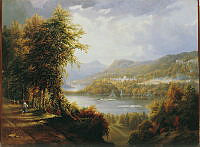
  • West Point Near Garrisons, White House Collection
    Robert Havell Jr.
    painting
    military
    landscapes
    New York
    Hudson River School
    White House Collection
    This painting was done by British-born artist Robert Havell, Jr. The painting depicts the buildings of the West Point military academy from across the Hudson River. Several boats ply the water in the center of the painting, while in the lower left corner a woman carries a basket and follows two cows walking down a dirt road. Havell is considered part of the Hudson River School and he best known as being the primary engraver for John James Audubon's Birds of America (1827-38), which brought him from Britain to the United States.
  • President's Standard May 29th 1916, White House Collection
    watercolor
    military
    flags
    White House Collection
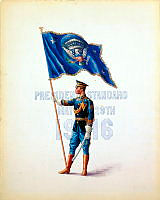
    This watercolor is by Edward C. Kuhn, an artist who worked for the U.S. Army. Kuhn did a series of six watercolors depicting the evolution of the President's Flag (also known as the President's Standard). All six are a part of the White House Collection including this one of a soldier waving the May 29, 1916 version.
  • President's Standard July 24th 1912, White House Collection
    watercolor
    military
    flags
    White House Collection
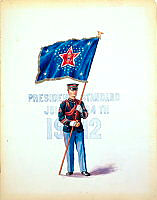
    This watercolor is by Edward C. Kuhn, an artist who worked for the U.S. Army. Kuhn did a series of six watercolors depicting the evolution of the President's Flag (also known as the President's Standard). All six are a part of the White House Collection including this one of a soldier waving the July 24, 1912 version.
  • President's Standard 1902, White House Collection
    Edward C. Kuhn
    watercolor
    military
    flags
    White House Collection
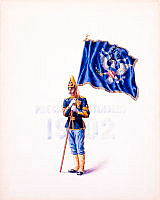
    This watercolor is by Edward C. Kuhn, an artist who worked for the U.S. Army. Kuhn did a series of six watercolors depicting the evolution of the President's Flag (also known as the President's Standard). All six are a part of the White House Collection including this one of a soldier waving the 1902 version.
  • President's Standard March 28, 1898, White House Collection
    watercolor
    military
    flags
    White House Collection
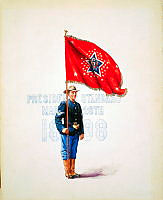
    This watercolor is by Edward C. Kuhn, an artist who worked for the U.S. Army. Kuhn did a series of six watercolors depicting the evolution of the President's Flag (also known as the President's Standard). All six are a part of the White House Collection including this one of a soldier waving the March 28, 1898 version.
  • President Buchanan Meets with Japanese Delegation, White House Collection
    Unknown
    military
    delegation
    White House Guests
    East Room
    White House Collection
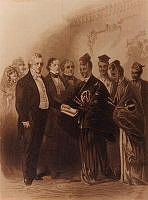
    This illustration depicts President James Buchanan meeting with the Japanese diplomatic delegation in 1860. This was the first visit of Japanese representatives to the United States. The May 17, 1860 meeting, one of several between the Japanese delegation and the President, took place in the East Room of the White House and was attended by members of the military, government, and clergy among other guests.
  • General William Henry Harrison at the Battle of Tippecanoe
    Nathaniel Currier
    military
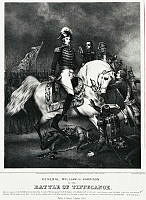
    This lithograph of General William Henry Harrison at the Battle of Tippecanoe was printed by Nathaniel Currier in 1840. The Battle of Tippecanoe was fought on November 7, 1811 between the United States Army and Tecumseh's American Indian Confederacy. Harrison is depicted on horseback with his sword drawn. The description at the bottom of the image describes General Harrison charging toward the enemy forces.
  • Battle of New Orleans and Defeat of the British Under the Command of Sir Edward Packenham
    James W. Steel
    War of 1812
    military
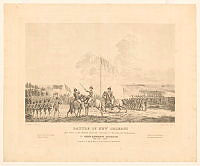
    This 1815 aquatint engraving by James W. Steel is titled "Battle of New Orleans and Defeat of the British Under the Command of Sir Edward Packenham." Gen. Andrew Jackson, center, is seen here receiving a salute from Gen. Richard Call. Maj. Edward Livingston is pictured riding behind Jackson. In the background American soldiers are fighting British troops. Jackson would go on to serve as the 7th president of the United States from March 4, 1829 to March 4, 1837. The engraving is based on a drawing by Samuel Seymour and published by William H. Morgan.
  • President Andrew Johnson Pardoning Rebels at the White House, White House Collection
    Harper's Weekly
    military
    Civil War
    White House Collection
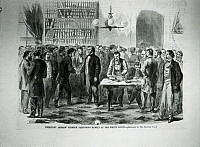
    This wood engraving was published in "Harper's Weekly" of President Andrew Johnson pardoning former Confederates at the White House. Johnson's decision to pardon Confederate rebels came in May 1865, shortly before his plan for Reconstruction policies in the United States. While there were exemptions to the proclamation, these pardons were generally for any Confederates who had not held office during the war, had not ascended above the rank of colonel in the army or lieutenant in the navy, and owned less than $20,000 worth of property. This policy upset many Republicans who believed that Johnson was far too lenient on the South for its rebellion against the federal government.
  • Abraham Lincoln & General Scott Review Volunteer Troops
    Alfred R. Waud
    military
    Civil War
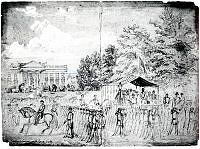
    This sketch was drawn in 1861 by Alfred R. Waud, an artist and illustrator who worked as a correspondent during the Civil War. The drawing was done on green paper using pencil and Chinese white, a white pigment used in watercoloring. In the drawing, President Abraham Lincoln and General Winfeld Scott review volunteer troops parading down Pennsylvania Avenue. President Lincoln and Scott stand under a tent erected outside the North Grounds of the White House, perhaps the first reviewing stand built near the White House grounds.
  • George Washington Triumphantly Entering Boston, White House Collection
    Unknown
    Military
    American Revolution
    White House Collection
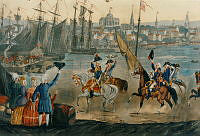
    This painting depicts George Washington on horseback triumphantly entering Boston in 1776. The painting was completed in 1834 by an unknown artist. Washington served as the Commander in Chief of the Continental Army during the American Revolution. He served as president from April 30, 1789 until March 4, 1797.
  • George Washington Accepts the Surrender of British General Cornwallis, White House Collection
    Jean Zuber et Cie
    Military
    American Revolution
    White House Collection
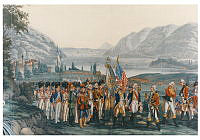
    This painting depicts George Washington accepting the surrender of British General Charles Cornwallis in 1781 after the battle of Yorktown. This painting was produced by Jean Zuber et Cie. of Rixheim, France in 1850. Zuber also produced the iconic wallpaper adorning the walls of the Diplomatic Reception Room that was installed by First Lady Jacqueline Kennedy. The room is located on the Ground Floor of the Executive Mansion. Washington served as the Commander in Chief of the Continental Army during the American Revolution. He served as president from April 30, 1789 until March 4, 1797.
  • Marine Band
    Barbara Gibson
    entertainment
    military
    holidays
    watercolor
    U.S. Marine Band
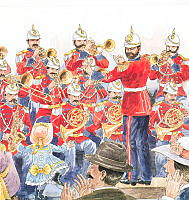
    This watercolor was painted in 2001 by Barbara Gibson. The Gibson's composition shows famous American composer and conductor John Philip Sousa conducting the U.S. Marine Band in 1889, during the Benjamin Harrison administration. Sousa is renowned for his famous marches including "The Stars and Stripes Forever", "Semper Fidelis", and "The Washington Post."
  • The Peacemakers by George Peter Alexander Healy (1813-1894), White House Collection
    G. P. A. Healy
    transportation
    military
    meetings
    Virginia
    Civil War
    White House Collection
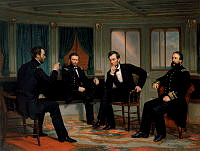
    This painting by George Peter Alexander Healy depicts a meeting late in the Civil War. In the cabin of the steamer The River Queen are seated (from left to right) Major General William T. Sherman, Lieutenant General Ulysses S. Grant, President Abraham Lincoln, and Rear Admiral David D. Porter. The meeting took place in March 1865 on the James River in City Point, Virginia, less than a week before the fall of Petersburg, Virginia. According to Porter, the discussion flowed mostly between Lincoln and Sherman, which is reflected in all four subjects' body languages. Sherman previously sat for a portrait by Healy and commissioned the artist to paint the meeting, providing him with first-hand accounts by himself and Porter as well as a diagram of the cabin. Born in Boston, Massachussetts, Healy was a popular portrait painter who sketched and painted Lincoln multiple times during his presidency.
  • President's Flag 1882, White House Collection
    watercolor
    military
    flags
    White House Collection
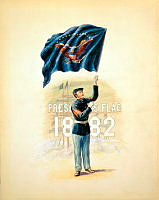
    This watercolor is by Edward C. Kuhn, an artist who worked for the U.S. Army. Kuhn did a series of six watercolors depicting the evolution of the President's Flag (also known as the President's Standard). All six are a part of the White House Collection including this one of a soldier waving the 1882 version.
  • President's Flag 1902, White House Collection
    Edward C. Kuhn
    watercolor
    military
    flags
    White House Collection
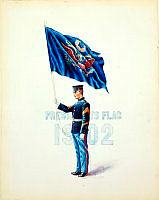
    This watercolor is by Edward C. Kuhn, an artist who worked for the U.S. Army. Kuhn did a series of six watercolors depicting the evolution of the President's Flag (also known as the President's Standard). All six are a part of the White House Collection including this one of a soldier waving the 1902 version.
  • John Hartwell Cocke of Bremo, White House Collection
    Edward Troye
    portraits
    military
    likeness
    Virginia
    White House Collection
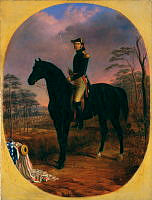
    This portrait by Edward Troye is of John Hartwell Cocke II, who built Bremo Plantation in Bremo Bluff, Virginia. Today, Bremo Plantation is listed on the National Register of Historic Places. In the painting, Cocke is horseback in military regalia with the American flag draped over a cannon by the horse's front legs and tents, possibly military barracks, in the distance. Troye was a Swiss-born painter who specialized in painting thoroughbred horses.
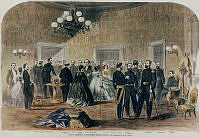
  • Grand Reception at the White House, January 1862, White House Collection
    Alfred R. Waud
    receptions
    military
    engraving
    State Floor
    New Year's
    Cabinet
    Blue Room
    White House Collection
    This hand-colored wood engraving by Alfred R. Waud appeared in the centerfold of Harper's Weekly on January 25, 1862. Waud made a sketch in person at the reception, which was the basis for the engraving. Abraham Lincoln, tallest man present, welcomes guests near a White House doorway during a Grand Reception in January 1862. Secretary of the Treasury Salmon P. Chase and his daughter Kate greet Mrs. Lincoln, while several Union Army officers fill out the scene.

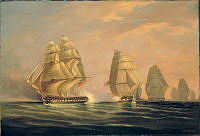
  • The First Naval Action in the War of 1812, White House Collection
    William John Huggins
    ships
    seascapes
    painting
    military
    War of 1812
    White House Collection
    This painting by William John Huggins depicts the first naval battle of the War of 1812, with several warships seen sailing on the horizon. The watercolor depicts the first naval action that broke out between the United States and Britain when the HMS Belvidera encountered the frigates USS President and USS United States and the sloops Hornet and Argos on June 23, 1812. The USS Congress, which was also present at the engagement, is not pictured. The British were not aware war had been declared when the American ships fired upon them. The Belvidera was able to evade and escape the confrontation. This same event is captured in a different painting in the White House Collection by James Stilwell. Huggins was a British artist well-known for his marine landscapes featuring ships.
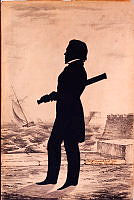
  • Commodore Uriah P. Levy, White House Collection
    Augustin-Amant-Constant-Fidèle Edouart
    silhouettes
    portraits
    military
    likeness
    White House Collection
    This silhouette made of cut paper with a charcoal background is of Commodore Uriah P. Levy and was done by Augustin-Amant-Constant-Fidèle Edouart, also known as Auguste Edouart. The full-body silhouette features Levy holding a telescope and looking out over stormy waters, including a boat being tossed about and fortifications along the shore. Levy was the first Jewish Commodore in the U.S. Navy and fought in the Barbary Wars and the War of 1812. Before joining the Navy, he volunteered with the Philadelphia militia in the American Revolution. Silhouette portraits were fashionable and readily available throughout Europe and the United States in the 1800s.