• Capture of the City of Washington
    J. & J. Cundee
    War of 1812
    Washington, D.C.
    engraving
    military
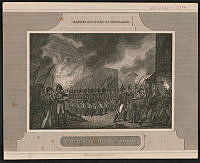
    This engraving of the capture of Washington, D.C. during the War of 1812 was created by London printers J and J Cundee in 1815 and used as an illustration in an edition of Paul Rapin's multi-volume "History of England." British troops entered and burned the capital, including the White House, on August 24, 1814. Though British forces occupied the city for only a short time, they inflicted serious damage. President James Madison escaped the White House before the attack, but finished out his second term in the nearby Octagon House and a row house in "Six Buildings" complex on Pennsylvania while the White House was rebuilt.
  • Writing-Arm Windsor Chair, White House Collection
    Unknown
    seats
    furniture
    White House Collection
    War of 1812
    furnishings
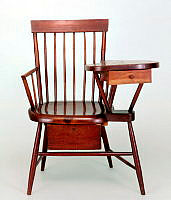
    This writing arm Windsor chair was used by President James Madison to write dispatches on August 27, 1814 in a house in Brookville, Maryland, where he took refuge after the British attack on Washington in 1814. The chair was returned to the White House in 1962, by a granddaughter of the family that had sheltered the president.
  • The First Naval Action in the War of 1812, White House Collection
    William John Huggins
    ship
    seascape
    War of 1812
    White House Collection
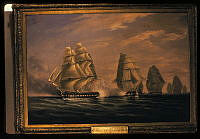
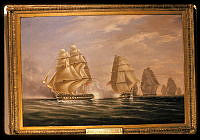
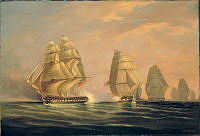
    This painting by William John Huggins depicting the first naval battle of the War of 1812, with several warships seen sailing on the horizon was completed in 1816. The watercolor captures the first naval action that broke out between the United States and Great Britain when the HMS Belvidera encountered the frigates USS President and USS United States and the sloops Hornet and Argus on June 23, 1812. The USS Congress, which was also present at the engagement, is not pictured. The British were not aware war had been declared when the American ships fired upon them. The Belvidera was able to evade and escape the confrontation. This same event is captured in a different painting in the White House Collection by James Stilwell. Huggins was a British artist well-known for his marine landscapes featuring ships. Bates Littlehales photographed the framed painting in March 1962 during the John F. Kennedy administration.
  • The First Naval Action in the War of 1812, White House Collection
    William John Huggins
    ship
    seascape
    War of 1812
    White House Collection
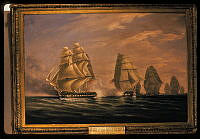
    This painting by William John Huggins depicting the first naval battle of the War of 1812, with several warships seen sailing on the horizon was completed in 1816. The watercolor captures the first naval action that broke out between the United States and Great Britain when the HMS Belvidera encountered the frigates USS President and USS United States and the sloops Hornet and Argus on June 23, 1812. The USS Congress, which was also present at the engagement, is not pictured. The British were not aware war had been declared when the American ships fired upon them. The Belvidera was able to evade and escape the confrontation. This same event is captured in a different painting in the White House Collection by James Stilwell. Huggins was a British artist well-known for his marine landscapes featuring ships. Bates Littlehales photographed the framed painting in March 1962 during the John F. Kennedy administration.
  • The First Naval Action in the War of 1812, White House Collection
    William John Huggins
    ship
    seascape
    War of 1812
    White House Collection
    This painting by William John Huggins depicting the first naval battle of the War of 1812, with several warships seen sailing on the horizon was completed in 1816. The watercolor captures the first naval action that broke out between the United States and Great Britain when the HMS Belvidera encountered the frigates USS President and USS United States and the sloops Hornet and Argus on June 23, 1812. The USS Congress, which was also present at the engagement, is not pictured. The British were not aware war had been declared when the American ships fired upon them. The Belvidera was able to evade and escape the confrontation. This same event is captured in a different painting in the White House Collection by James Stilwell. Huggins was a British artist well-known for his marine landscapes featuring ships. Bates Littlehales photographed the framed painting in March 1962 during the John F. Kennedy administration.
  • The Fall of Washington or Maddy in Full Flight
    S. W. Fores
    political cartoon
    War of 1812
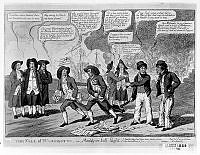
    This illustration, titled "The Fall of Washington or Maddy in Full Flight," was created in October 1814 by Samuel William Fores, also known as S. W. Fores. This British cartoon depicts the retreat of President James Madison during the invasion of Washington, D.C. by British troops in the War of 1812. Underneath the illustration is a quotation from William Shakespeare's "Macbeth." It reads, "Death of thy Soul. Those linen cheeks of thine; Are Counsellors to fear."
  • Battle of New Orleans and Defeat of the British Under the Command of Sir Edward Packenham
    James W. Steel
    War of 1812
    military
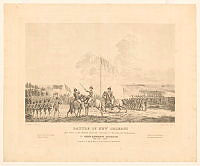
    This 1815 aquatint engraving by James W. Steel is titled "Battle of New Orleans and Defeat of the British Under the Command of Sir Edward Packenham." Gen. Andrew Jackson, center, is seen here receiving a salute from Gen. Richard Call. Maj. Edward Livingston is pictured riding behind Jackson. In the background American soldiers are fighting British troops. Jackson would go on to serve as the 7th president of the United States from March 4, 1829 to March 4, 1837. The engraving is based on a drawing by Samuel Seymour and published by William H. Morgan.
  • Defeat of the English Boat Guerriere by the American Boat Constitution, White House Collection
    Unknown
    ships
    seascapes
    painting
    War of 1812
    White House Collection
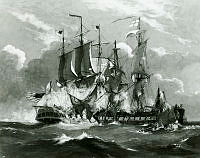
    This seascape was done by an unknown artist. The painting depicts the victory of the USS Constitution over the HMS Guerriere on August 19, 1812. The painting shows the Guerriere with broken masts and smoke and fire consuming the defeated ship.

  • The First Naval Action in the War of 1812, White House Collection
    William John Huggins
    ships
    seascapes
    painting
    military
    War of 1812
    White House Collection
    This painting by William John Huggins depicts the first naval battle of the War of 1812, with several warships seen sailing on the horizon. The watercolor depicts the first naval action that broke out between the United States and Britain when the HMS Belvidera encountered the frigates USS President and USS United States and the sloops Hornet and Argos on June 23, 1812. The USS Congress, which was also present at the engagement, is not pictured. The British were not aware war had been declared when the American ships fired upon them. The Belvidera was able to evade and escape the confrontation. This same event is captured in a different painting in the White House Collection by James Stilwell. Huggins was a British artist well-known for his marine landscapes featuring ships.
  • Richard Henry Shaw, White House Collection
    Unknown
    watercolor
    portraits
    likeness
    War of 1812
    White House Collection
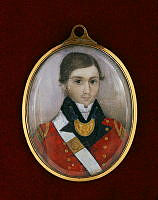
    This watercolor painting on ivory of Richard Henry Shaw was done by an unknown English artist. Shaw was a member of the King's Own Royal Regiment (Fourth Regiment of Foot) and participated in the invasion of Washington in 1814.
  • First Action of War 1812, White House Collection
    James Stilwell
    ships
    seascapes
    painting
    War of 1812
    White House Collection
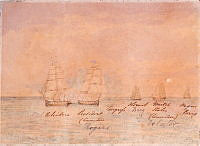
    This painting of ships engaged in a broadside at the beginning of the War of 1812 was done by James Stilwell. The painting depicts the first naval action that broke out between the United States and Britain when the HMS Belvidera encountered the frigates USS President and USS United States and the sloops Hornet and Argos on June 23, 1812. The USS Congress, which was also present at the engagement, is not pictured. The British were not aware war had been declared when the American ships fired upon them. The Belvidera was able to evade and escape the confrontation. Someone penciled in the names of the respective ships and their commanders over the painting. This same event is captured in a different painting in the White House Collection by William John Huggins.
  • Richard Henry Shaw, White House Collection
    Unknown
    watercolor
    portraits
    likeness
    War of 1812
    White House Collection
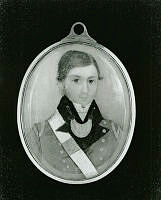
    This portrait of Richard Henry Shaw is in the form of a pendant and was done by an unknown English artist. Shaw was a member of the King's Own Royal Regiment and participated in the invasion of Washington in 1814.