• Lorraine Waxman Pearce Collection Compilation
    White House Historical Association
    vases
    staff
    restoration
    construction & maintence
    china
    White House Collection
    WHHA
    State Floor
    State Dining Room
    Roosevelt Room
    Blue Room
    Map Room
    Ground Floor
    Residence staff
    documents
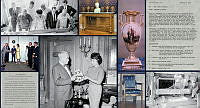
    This composite is a compilation of materials from the Lorraine Waxman Pearce Collection and other sources. Lorraine Waxman Pearce served as the first White House Curator from 1961 to 1962. This composite may only be used for press and publicity purposes related to the collection. All other uses must be approved by the White House Historical Association in writing.
  • Sugar Bowl, Washington State Service, White House Collection
    Unknown
    tableware
    serveware
    State Service
    tea services
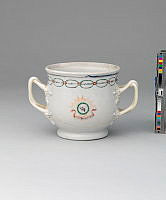
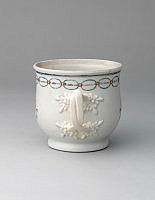
    This sugar bowl was produced in 1795 and presented to First Lady Martha Washington in 1796 by a director of the Dutch East India Company. The bowl was part a Chinese Export porcelain service and originally had a lid. It was decorated with her initials and a border of chain links representing the 15 states of the Union, the service was used in the Washingtons’ Philadelphia residence. As a result of increased sugar production due to growth of sugar plantations fueled by the Atlantic slave trade, sugar bowls became popular pieces of tableware. The Washingtons may have displayed it in public spaces alongside other fine tableware, exhibiting their wealth, worldliness, and patriotism to guests dining at their home.

  • Sugar Bowl, Washington State Service, White House Collection
    Unknown
    tableware
    serveware
    State Service
    tea services
    This sugar bowl was produced in 1795 and presented to First Lady Martha Washington in 1796 by a director of the Dutch East India Company. The bowl was part a Chinese Export porcelain service and originally had a lid. It was decorated with her initials and a border of chain links representing the 15 states of the Union, the service was used in the Washingtons’ Philadelphia residence. As a result of increased sugar production due to growth of sugar plantations fueled by the Atlantic slave trade, sugar bowls became popular pieces of tableware. The Washingtons may have displayed it in public spaces alongside other fine tableware, exhibiting their wealth, worldliness, and patriotism to guests dining at their home.
  • Lithograph of President Abraham Lincoln
    Currier & Ives
    portrait
    print
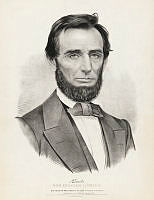
    This lithograph of President Abraham Lincoln was created by Currier & Ives Lithography Company circa 1860-1861. In late 1860, Abraham Lincoln began growing a beard, and was the first United States president to do so. After his first election, he reportedly received a letter from an eleven-year-old fan, Grace Bedell, who suggested that growing facial hair might improve his appearance. In his reply to this letter, President Lincoln wrote, “As to the whiskers, having never worn any, do you not think people would call it a piece of silly affectation if I were to begin wearing them now? Your very sincere well-wisher," A. LINCOLN."” By 1861, Lincoln’s beard appeared in portraits, paintings, and photographs, and would remain a style that he maintained for the remainder of his life. Lincoln became president on March 4, 1861 and had earlier served in the House of Representatives.
  • Portrait of Young John Quincy Adams
    Izaak Schmidt
    portrait
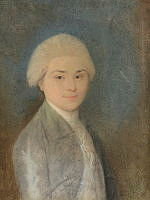
    This pastel on vellum portrait of future president John Quincy Adams was created by Izaak Schmidt in 1783. Beginning in 1779, John Quincy Adams kept a detailed diary, recording his daily activities in Europe. Though he occasionally mentioned his dress in passing, he provided little description, focusing instead on his studies and travels. In 1783, while staying in The Hague, Adams sat for a portrait. This painting reflects how his style as a young man was influenced by the prevailing fashions of France and Great Britain. He is depicted wearing a slim-fitting frock coat with a wide, turned-down collar, a colorful waistcoat (possibly embroidered), and powdered hair; styles that were popular at the time among young men in Western Europe. John Quincy Adams was the son of President John Adams and First Lady Abigail Adams. Prior to his presidency, President Adams was a diplomat to the Netherlands, Prussia, Russia, and the United Kingdom. He served as Secretary of State under President James Monroe and is the only president who went on to serve in the United States House of Representatives after being president. Adams represented his home state, Massachusetts, in the House.
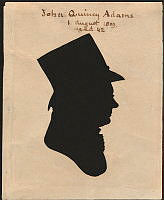
  • Silhouette of John Quincy Adams
    H. Williams
    silhouette
    likeness
    portraits
    This ink on paper silhouette portrait of future president John Quincy Adams was created by Henry Williams (professionally knowns as H. Williams) in 1809 and depicts Adams wearing a top hat. Adams was an early adopter of the top hat, despite its decline in popularity in the late 1700s. By the early 1800s, top hats served as a sign of status, and fashionable men would not have been seen in public without the latest hat style. While Adams is not usually pictured wearing a hat in his portraits, in this 1809 silhouette, his top hat is in the popular fashion of the time, around six or seven inches tall, with a narrow brim curving downward at the front and back. Silhouette portraits were fashionable and readily available throughout Europe and the United States in the 1800s. John Quincy Adams was the son of President John Adams and First Lady Abigail Adams. Prior to his presidency, President Adams was a diplomat to the Netherlands, Prussia, Russia, and the United Kingdom. He served as Secretary of State under President James Monroe and is the only president who went on to serve in the United States House of Representatives after being president. Adams represented his home state, Massachusetts, in the House.
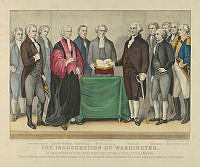
  • The Inauguration of President George Washington
    Currier & Ives
    print
    inagurations
    This hand-colored lithograph by Currier & Ives was published in 1876 and depicts the Inauguration of President George Washington. Eleven men are depicted witnessing Washington taking the Oath of Office. He places his right hand on an open bible and holds a sword with his left hand. Figures noted in the key below the image include Alexander Hamilton, Chancellor Robert R. Livingston, Roger Sherman, Mr. Otis, John Adams, Baron Friedrich Wilhelm Steuben, and General Henry Knox. Washington served as the Commander in Chief of the Continental Army during the American Revolution. He served as president from April 30, 1789 until March 4, 1797.