• White House Staff Get Fingerprinted at President Roosevelt's Request
    Harris & Ewing
    staff
    Residence staff
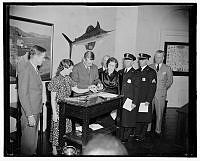
    This photograph of members of the White House staff getting fingerprinted was taken by Harris & Ewing on March 21, 1939. President Franklin D. Roosevelt stated during a press conference that everyone in the White House, including the president, should be fingerprinted. This photograph captures the day the initiative started. From left to right are: White House carpenter Isaac Avery, stenographer Mollie D. Somerville, E.A. Schurman, who took the fingerprints, a Secret Service agent, carpenter E.L. Lewis, clerk Muriel Lund, Sgt. Ole Jacobson, acting Capt. Herbert L. Macy of the White House Police Force, and usher Wilson Searles.
  • White House Housekeeper Henrietta Nesbitt
    Harris & Ewing
    staff
    Residence staff
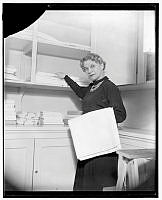
    This photograph of Victoria D. H. Nesbitt (also referred to as Henrietta Nesbitt) was taken by Harris & Ewing in February 1939. Nesbitt served as White House housekeeper primarily during the Franklin D. Roosevelt administration from 1933 to 1946.
  • Chief Usher Raymond Muir and Carpenter Isaac Avery with Chesapeake Bay Bluefish
    Harris & Ewing
    Residence staff
    staff
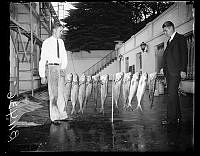
    This photograph of White House Chief Usher Raymond Muir (right) and carpenter Isaac Avery (left) was taken by the National Photo Company in October 1936. Muir worked as an usher from 1930 to 1938 and was named Chief Usher in 1933. Avery was a White House carpenter from 1930 to 1965. The two are photographed with Bluefish caught in the Chesapeake Bay.
  • White House Chief Usher Howell Crim and Usher Charles Claunch
    Harris & Ewing
    Residence staff
    staff
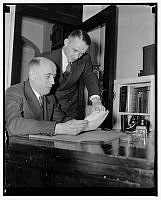
    This photograph of White House Chief Usher Howell G. Crim (sitting) and usher Charles K. Claunch was taken by Harris & Ewing on April 4, 1938. This photograph was taken shortly after President Franklin D. Roosevelt named Crim to the Chief Usher role, following the departure of Raymond Muir. Crim worked at the White House circa 1930 to 1957. Claunch served as a naval aid before becoming usher, from 1929 to 1954.
  • Allan M. Thomas Hangs Wreath Over the North Door
    Harris & Ewing
    staff
    Residence staff
    North Door
    winter holidays
    Christmas
    decorations
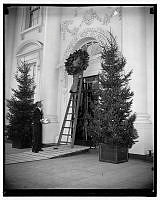
    This photograph of electrician Allan M. Thomas hanging a Christmas wreath above the North Door of the White House was taken by Harris & Ewing on December 21, 1937. Thomas worked as an electrician at the White House from 1912 to 1945.
  • First Lady Grace Coolidge in Sleigh Outside the White House with Ike Hoover
    Harris & Ewing
    staff
    Residence staff
    North Grounds
    North Drive
    transportation
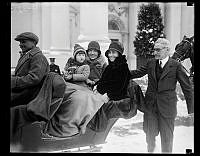
    In this photograph, taken by Harris & Ewing circa 1929, First Lady Grace Goodhue Coolidge rides in a sleigh outside the North Portico of the White House. Chief Usher Irwin "Ike" Hood Hoover stands to the far right. Hoover worked at the White House from 1891 to 1933, initially as an electrician and then as Chief Usher.
  • White House Grounds Staff on the South Lawn
    Harris & Ewing
    staff
    Residence staff
    South Grounds
    South Lawn
    south view
    South Portico
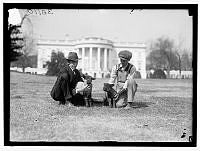
    This photograph of two members of the White House Grounds staff was taken by Harris & Ewing circa 1916 to 1919. The two men are seen feeding two sheep on the South Lawn of the White House. It is possible these sheep were among the flock employed by President Woodrow Wilson to graze on the South Lawn, enabling the lawn to be maintained while men were at war and using the wool from the sheep to be sold as a fundraiser for the Red Cross.
  • Samuel M. Biggs Mows the Lawn Outside the West Wing
    Harris & Ewing
    staff
    Residence staff
    North Grounds
    West Wing
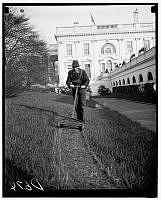
    This photograph of Samuel "Sam" M. Biggs mowing the lawn outside the West Wing was taken on January 27, 1937. Biggs worked at the White House circa 1929 to 1937. Over the course of his career at the White House he worked as a laborer, yardman, and gardener.
  • Gardeners John Smith and Leroy Lyons Mow the South Lawn
    Harris & Ewing
    staff
    Residence staff
    South Grounds
    South Lawn
    south view
    South Portico
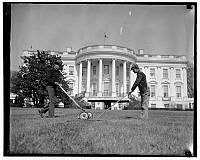
    This photograph of two White House gardeners was taken by Harris & Ewing circa 1939. The two gardeners, Leroy Lyons and John Smith, are captured mowing the South Lawn of the White House, with the South Portico visible in the background. Lyons worked as a gardener and, later, in the White House Flower Shop from circa 1934 to circa 1961.
  • President Truman Congratulates Mays and Jackson on 41 Years Working at the White House
    Harris & Ewing
    staff
    Residence staff
    West Wing
    Oval Office
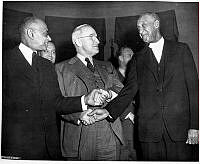
    This photograph of President Harry S. Truman with John W. Mays, right, and Samuel C. Jackson, left, was taken by Harris & Ewing on March 4, 1950. President Truman is captured celebrating Mays and Jackson for their 41 years of working at the White House. Both men began working on March 4, 1909. Mays, who held many roles in the White House including doorkeeper, messenger, and barber, would continue to work at the White House until 1953. Jackson, a doorman, messenger, and custodian over the course of his career, retired from the White House in 1951. Truman presented Mays and Jackson with autographed dollar bills to honor their milestone.
  • Charles Henlock, White House Gardener
    Harris & Ewing
    staff
    Residence staff
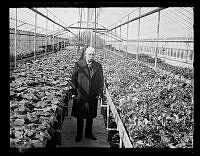
    This photograph of Charles Henlock, White House gardener, was taken circa 1931. Henlock arrived in the United States from England in 1886, the same year he began working at the White House as a laborer. He was eventually promoted to head gardener, where he oversaw the gardens and grounds and managed the propagation of plants in the White House Conservatory. With the demolition of the Conservatory in 1902 to make way for the construction of the West Wing, Henlock moved to the greenhouses' new location on the National Mall. Henlock worked with several first ladies to select the florals for everything from formal events like State Dinners and Inaugural Balls to everyday decorations around the White House. Henlock was also involved with annual events on the White House Grounds like the White House Easter Egg Roll and the lighting of the National Christmas tree. Later in his career, Henlock was promoted to chief of the Horticultural Division of the Office of Public Buildings and Public Parks, overseeing the hundreds of thousands of plants around Washington, D.C. He was well-known for his estimating the peak bloom for the cherry blossom trees surrounding the Tidal Basin in Washington. In 1931, following 45 years of service, Henlock left his role due to the Civil Service Commission regulations outlining mandatory retirement. He then served the White House gardens in an advisory capacity until his death in 1934.
  • East Room Decorated for the Roosevelt-Longworth Wedding
    Harris & Ewing
    weddings
    State Floor
    East Room
    celebrations
    decorations
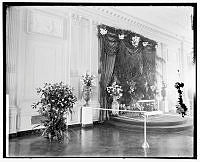
    In this photograph, the East Room of the White House is elegantly decorated for the wedding of Alice Roosevelt to Nicholas Longworth, which took place on February 17, 1906. Alice Roosevelt, daughter of President Theodore Roosevelt and Alice Lee Roosevelt, married Longworth, a member of the House of Representatives from the state of Ohio, before an estimated one thousand guests in attendance. The dais, pictured here, was set up along the large window on the east side of the room. Astilbe japonicas, palm fronds, Easter lilies, greenhouse smilax, asparagus vines, bride roses, and rhododendrons filled the room and white satin ribbons covered the ropes that created the aisle amongst all of the invited guests.
  • Flower Girls for the Wilson-McAdoo Wedding
    Harris & Ewing
    celebrations
    weddings
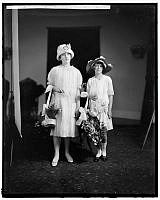
    This photograph captures two flower girls dressed in their wedding ensembles with baskets of flowers for the wedding ceremony of Eleanor Wilson and William G. McAdoo (sometimes referred to as W. G. McAdoo). Eleanor Wilson, daughter of President Woodrow Wilson and First Lady Ellen Axson Wilson, married McAdoo, President Wilson's secretary of the Treasury, in the East Room of the White House on May 7, 1914. The flower girls were likely dressed in custom Kurzman dresses. It is believed that Kurzman created the gowns for Eleanor’s trousseau as well as the whole family.
  • Wedding Portrait of Eleanor Wilson McAdoo
    Harris & Ewing
    celebrations
    weddings
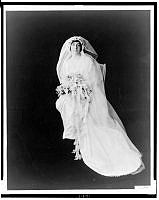
    This portrait photograph of Eleanor Wilson McAdoo in her wedding gown was taken by Harris & Ewing. Eleanor Wilson McAdoo, daughter of President Woodrow Wilson and First Lady Ellen Axson Wilson, married William G. McAdoo (sometimes referred to as W. G. McAdoo) in the East Room of the White House on May 7, 1914. McAdoo served as the secretary of the Treasury during the Woodrow Wilson administration. Eleanor Wilson McAdoo wore an ivory white satin fabric for the base of her wedding gown, which was custom-made by New York designer Charles Kurzman of Kurzman of Fifth Avenue. The dress featured a v-shaped neckline, long sleeves of tulle, a three and a half foot-long train, and was trimmed with rare old point lace. Her tulle veil attached to a cap with orange blossoms and carried a bouquet of orange blossoms, white lilies of the valley, and white orchids.
  • East Room Decorated for the Wilson-Sayre Wedding
    Harris & Ewing
    weddings
    celebrations
    State Floor
    East Room
    decorations
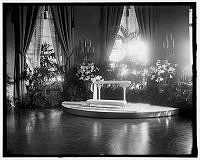
    In this photograph, the East Room of the White House is decorated for the wedding of Jessie Woodrow Wilson, daughter of President Woodrow Wilson and First Lady Ellen Axson Wilson, to Francis Bowes Sayre on November 25, 1913. The ceremony took place at an altar constructed in the East Room surrounded by palms, maidenhair ferns, and annunciation lilies, which complemented Jessie’s bouquet.
  • The White House in Snow, Coolidge Administration
    Harris & Ewing
    snow
    north view
    North Grounds
    North Drive
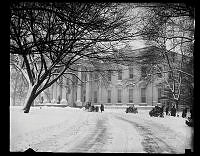
    This photograph of the White House following a snowfall was taken around 1927 to 1928 during the Calvin Coolidge administration. A snowplow can be seen up the North Drive as it approaches the North Portico. A line of workers are also captured shoveling snow at the right.

  • Rep. Byrns with a Portrait of Sarah Yorke Jackson
    Harris & Ewing
    Congress
    west view
    arts & culture
    ceremonies
    dedication
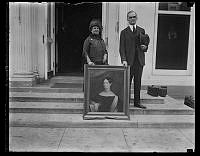
    This photograph from Harris & Ewing is of Representative Joseph "Jo" Wellington Byrns of Tennessee outside the West Wing circa 1920-1921. Byrns is photographed with an unnamed woman and a portrait of Sarah Yorke Jackson, the wife of Andrew Jackson Jr., who was the adopted son of President Andrew Jackson. Sarah filled the role of White House hostess during the last months of the Jackson administration and her portrait was added to the White House Collection in 1924. Byrns would go on to serve as the 41st Speaker of the United States House of Representatives from 1935 to 1936. To see the portrait of Sarah Yorke Jackson, see asset 3735 in the Digital Archives.
  • Donation of G. P. A. Healy's Portrait of Abraham Lincoln
    Harris & Ewing
    military
    dedication
    ceremonies
    arts & culture
    Residence staff
    staff
    In this photograph, Capt. Howard Ker of the United States Army Corp of Engineers accepts the donation of G. P. A. Healy's 1869 portrait of President Abraham Lincoln at the White House on March 22, 1939. Capt. Ker was in charge of the buildings and grounds of the White House at the time. The portrait came into possession of the White House following the death of Mary Harlan Lincoln (wife of President Lincoln's eldest son, Robert Todd Lincoln) in 1937 and her daughter, Mary Todd "Mamie" Lincoln Isham, in 1938. According to her will, the portrait of President Lincoln was to be offered to the U.S. government following the death of her daughter as long as it was promised to be placed on display in the White House. To see Healy's portrait of President Lincoln, see asset number 5 in the Digital Archives.
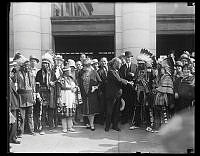
  • Vice President Curtis Greets Native Americans
    Harris & Ewing
    American Indians
    This photograph shows Vice President Charles Curtis greeting a group of people. The group includes several American Indians dressed in traditional attire. Born in Kansas to a white father and Native American mother, and raised by his maternal grandparents, Curtis was the first person of Native American descent as well as the first person of color to serve as vice president. He served as vice president for President Herbert Hoover.
  • National Christmas Tree Lighting, 1932
    Harris & Ewing
    winter holidays
    Ellipse
    Christmas
    Christmas Tree lighting
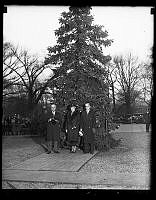
    In this photograph, taken on December 24, 1932, Vice President Charles Curtis, his wife Anna Baird Curtis, and Senator Arthur Capper of Kansas pose in front of the National Christmas Tree during the National Christmas Tree lighting ceremony on the Ellipse. This was the first year the president was not in attendance since the ceremony's induction in 1924; Vice President Curtis lit the tree on behalf of President Herbert Hoover. The ceremony also marked the first instance of the "Singing Tree" tradition, in which the sound of Christmas carols played on a Victrola in a nearby police box could be heard over loudspeakers hidden in the tree.
  • Vice President Curtis Throws Opening Pitch at Congressional Baseball Game
    Harris & Ewing
    sports
    Washington, D.C.
    Congress
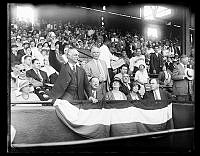
    In this photograph, taken on June 4, 1932, Vice President Charles Curtis throws the opening pitch at the Congressional Baseball Game at Griffith Stadium in Washington, D.C. The friendly competition between Republican and Democrat members of Congress was first held in 1909, and soon became an anticipated tradition. The first Congressional Baseball Game since the start of the Great Depression, the 1932 game was held as a fundraiser to benefit unemployed people in the District of Columbia. The Republicans defeated the Democrats with a final score of 19-5.
  • President Coolidge Signs Kellogg-Briand Peace Pact
    Harris & Ewing
    treaties
    signing
    State Floor
    East Room
    Congress
    Cabinet
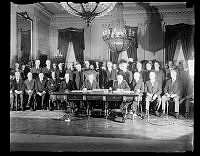
    In this photograph, taken on January 17, 1929, President Calvin Coolidge signs the Kellogg-Briand Peace Pact in the East Room of the White House. Crafted by Secretary of State Frank B. Kellogg and French Foreign Minister Aristide Briand in light of the casualties that resulted from World War I, the international peace proposal committed 15 nations to outlawing aggression and war in settling disputes. The agreement was signed in Paris on August 27, 1928 and signed by Coolidge following ratification by Congress. Here, Coolidge signs the agreement on the former Cabinet table purchased for the White House during the Ulysses S. Grant administration. Among those in also attendance were Vice President Charles Gates Dawes, Secretary of State Frank B. Kellogg, Secretary of the Treasury Andrew W. Mellon, Secretary of War Dwight Filley Davis, Senator William Edgar Borah, Senator Claude Augustus Swanson, and Vice President-elect Charles Curtis.
  • Hoover Cabinet Members Visit White House at Christmastime
    Harris & Ewing
    winter holidays
    decorations
    North Portico
    North Door
    Cabinet
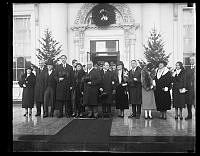
    In this photograph, guests including members of President Herbert Hoover's Cabinet and their spouses pose outside of the North Door of the White House. Trees flank either side of the door and a wreath hangs above for the holiday season. Among those pictured here is Vice President Charles Curtis, Secretary of the Navy Charles Francis Adams III, and Secretary of the Interior Ray Lyman Wilbur.
  • President Franklin D. Roosevelt Greets Native Americans
    Harris & Ewing
    transportation
    South Lawn
    South Grounds
    American Indians
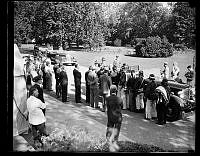
    In this photograph, taken in May 1936, President Franklin D. Roosevelt receives a group of American Indians from the Pueblo nation on the South Drive. The president is pictured seated in an open convertible. The guests visited the White House to express support for legislation sponsored by U.S. Commissioner for the Bureau of Indian Affairs John Collier, which protected Pueblo land from encroaching agricultural interests.
  • President Coolidge with American Indian Delegation
    Harris & Ewing
    American Indians
    delegation
    west view
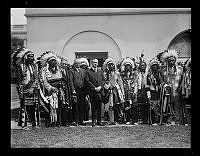
    In this photograph, President Calvin Coolidge poses alongside a group of American Indian men outside the West Wing of the White House. Following the enactment of the Indian Citizenship Act in 1924, Coolidge invited delegations from many American Indian nations to the White House. During his presidency, Coolidge increased public perception of the challenges faced by American Indian communities, while promoting assimilation into American society.