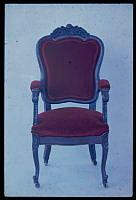
• Rococo-Revival Armchair, White House Collection
    Unknown
    seats
    furniture
    furnishings
    White House Collection
    This Rococo-Revival armchair was taken by George F. Mobley in 1962. It is similar to the one in G. P. A. Healy's famous portrait of President Abraham Lincoln. The chair was found in storage and reupholstered in wine-red velvet that was popular in the Victorian era. White House Curator Lorraine Waxman Pearce was most likely responsible for researching and arranging for the chair's restoration. This photograph is part of the Lorraine Waxman Pearce Collection. Lorraine Waxman Pearce served as the first White House Curator from 1961 to 1962. As curator, she oversaw refurbishment projects, implemented collections policies, and collaborated with First Lady Jacqueline Kennedy to write the first White House guidebook—a joint publication of the National Geographic Society and the White House Historical Association. Since its original publication in 1962, “The White House: An Historic Guide” has been revised, updated, and printed for over 60 years.
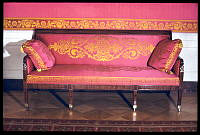
  • Mahogany Empire Sofa, White House Collection
    Unknown
    White House Collection
    furnishings
    furniture
    seats
    This mahogany sofa was crafted in the Empire style with bronze sphinx heads decorating the corners under the arm supports. The sofa is believed to have belonged to First Lady Dolley Madison. This photograph captures the sofa as it appeared in the Red Room, during the John F. Kennedy administration. The silk upholstery was the same as the wall coverings at the time. This photograph is part of the Lorraine Waxman Pearce Collection. Lorraine Waxman Pearce served as the first White House Curator from 1961 to 1962. As curator, she oversaw refurbishment projects, implemented collections policies, and collaborated with First Lady Jacqueline Kennedy to write the first White House guidebook—a joint publication of the National Geographic Society and the White House Historical Association. Since its original publication in 1962, “The White House: An Historic Guide” has been revised, updated, and printed for over 60 years.
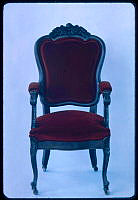
  • Rococo-Revival Armchair, White House Collection
    Unknown
    seats
    furniture
    furnishings
    White House Collection
    This Rococo-Revival armchair was taken by George F. Mobley in 1962. It is similar to the one in G. P. A. Healy's famous portrait of President Abraham Lincoln. The chair was found in storage and reupholstered in wine-red velvet that was popular in the Victorian era. White House Curator Lorraine Waxman Pearce was most likely responsible for researching and arranging for the chair's restoration. This photograph is part of the Lorraine Waxman Pearce Collection. Lorraine Waxman Pearce served as the first White House Curator from 1961 to 1962. As curator, she oversaw refurbishment projects, implemented collections policies, and collaborated with First Lady Jacqueline Kennedy to write the first White House guidebook—a joint publication of the National Geographic Society and the White House Historical Association. Since its original publication in 1962, “The White House: An Historic Guide” has been revised, updated, and printed for over 60 years.
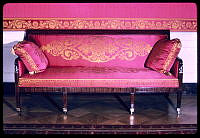
  • Mahogany Empire Sofa, White House Collection
    Unknown
    White House Collection
    furnishings
    furniture
    seats
    This mahogany sofa was crafted in the Empire style with bronze sphinx heads decorating the corners under the arm supports. The sofa is believed to have belonged to First Lady Dolley Madison. This photograph captures the sofa as it appeared in the Red Room, during the John F. Kennedy administration. The silk upholstery was the same as the wall coverings at the time. This photograph is part of the Lorraine Waxman Pearce Collection. Lorraine Waxman Pearce served as the first White House Curator from 1961 to 1962. As curator, she oversaw refurbishment projects, implemented collections policies, and collaborated with First Lady Jacqueline Kennedy to write the first White House guidebook—a joint publication of the National Geographic Society and the White House Historical Association. Since its original publication in 1962, “The White House: An Historic Guide” has been revised, updated, and printed for over 60 years.
  • Mirror, Red Room, White House Collection
    Unknown
    State Floor
    Red Room
    White House Collection
    mirrors
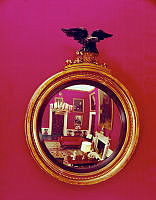
    This photograph of a circular mirror with a decorative eagle in the Red Room was shot in such a way that a reflection of the room's furnishings are displayed. The photograph was taken by George Mobley of the National Geographic Service.
  • Clock and Barometer from U.S.S. Williamsburg, Cabinet Room, White House Collection
    Unknown
    mantels
    clocks
    White House Collection
    Cabinet Room
    furnishings
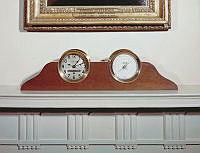
    This dual-faced clock with timepiece and barometer was photographed on the mantel of the Cabinet Room in 1960. It was originally from the U.S.S. Williamsburg, the Presidential yacht during the Truman administration. This photograph was taken by George Mobley of the National Geographic Service.

  • American Empire Style Side Chair, White House Collection
    Unknown
    White House Collection
    seats
    furniture
    furnishings
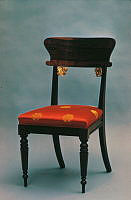
    This side chair is considered to be of the late Sheraton style and the early American Empire Style. The seat is rectangular and the front two legs are tapered. The chair has a curved top rail with two decorative and gilded brackets adjoined to the chair's top rail and stiles. The side chair was photographed by George Mobley of the National Geographic Service in 1958.
  • Dessert Plate, Polk State Service, White House Collection
    Edouard D. Honoré
    dishes
    White House Collection
    State Service
    tableware
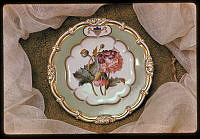
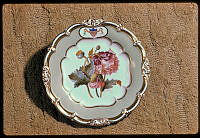
    This French porcelain dessert plate was made for the White House by Edouard Honoré of Paris in 1846. President James Polk K. ordered this pattern for the state service. The plate features a gilded rim molded in a scroll design and a light green border. At the top of the plate is a version of the shield from the Great Seal of the United States, although this one contains stars in the chief which are not present on the Great Seal or Presidential Seal, and the scroll containing the motto "E Pluribus Unum." The dessert plates also included a large flower, such as the poppy shown here. George F. Mobley photographed the plate in 1962, during the John F. Kennedy administration.
  • Trumeau, White House Collection
    Unknown
    mirror
    Second Floor
    Queen's Bedroom
    painting
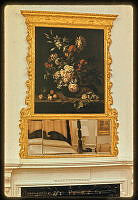
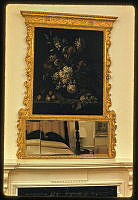
    This trumeau, a mirror and painting framed together, was presented to President Harry S. Truman and First Lady Elizabeth "Bess" Truman by Queen Elizabeth II, then Princess Elizabeth, Duchess of Edinburgh, on behalf of her father, King George VI of Great Britain, during her visit to Washington in 1951. This trumeau features a still life of flowers and fruit and a three part mirror with a gilded frame. This trumeau has historically hung above the mantel in the Queens' Bedroom. The trumeau was photographed in April 1962, during the John F. Kennedy administration.
  • Trumeau, White House Collection
    Unknown
    mirror
    Second Floor
    Queen's Bedroom
    painting
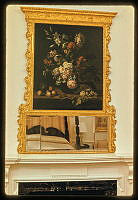
    This trumeau, a mirror and painting framed together, was presented to President Harry S. Truman and First Lady Elizabeth "Bess" Truman by Queen Elizabeth II, then Princess Elizabeth, Duchess of Edinburgh, on behalf of her father, King George VI of Great Britain, during her visit to Washington in 1951. This trumeau features a still life of flowers and fruit and a three part mirror with a gilded frame. This trumeau has historically hung above the mantel in the Queens' Bedroom. The trumeau was photographed in April 1962, during the John F. Kennedy administration.
  • Trumeau, White House Collection
    Unknown
    mirror
    Second Floor
    Queen's Bedroom
    painting
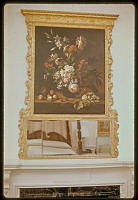
    This trumeau, a mirror and painting framed together, was presented to President Harry S. Truman and First Lady Elizabeth "Bess" Truman by Queen Elizabeth II, then Princess Elizabeth, Duchess of Edinburgh, on behalf of her father, King George VI of Great Britain, during her visit to Washington in 1951. This trumeau features a still life of flowers and fruit and a three part mirror with a gilded frame. This trumeau has historically hung above the mantel in the Queens' Bedroom. The trumeau was photographed in April 1962, during the John F. Kennedy administration.
  • Trumeau, White House Collection
    Unknown
    mirror
    Second Floor
    Queen's Bedroom
    painting
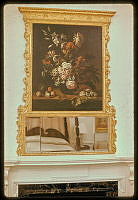
    This trumeau, a mirror and painting framed together, was presented to President Harry S. Truman and First Lady Elizabeth "Bess" Truman by Queen Elizabeth II, then Princess Elizabeth, Duchess of Edinburgh, on behalf of her father, King George VI of Great Britain, during her visit to Washington in 1951. This trumeau features a still life of flowers and fruit and a three part mirror with a gilded frame. This trumeau has historically hung above the mantel in the Queens' Bedroom. The trumeau was photographed in April 1962, during the John F. Kennedy administration.
  • Trumeau, White House Collection
    Unknown
    mirror
    Second Floor
    Queen's Bedroom
    painting
    This trumeau, a mirror and painting framed together, was presented to President Harry S. Truman and First Lady Elizabeth "Bess" Truman by Queen Elizabeth II, then Princess Elizabeth, Duchess of Edinburgh, on behalf of her father, King George VI of Great Britain, during her visit to Washington in 1951. This trumeau features a still life of flowers and fruit and a three part mirror with a gilded frame. This trumeau has historically hung above the mantel in the Queens' Bedroom. The trumeau was photographed in April 1962, during the John F. Kennedy administration.
  • Dessert Plate, Polk State Service, White House Collection
    Edouard D. Honoré
    dishes
    White House Collection
    State Service
    tableware
    This French porcelain dessert plate was made for the White House by Edouard Honoré of Paris in 1846. President James Polk K. ordered this pattern for the state service. The plate features a gilded rim molded in a scroll design and a light green border. At the top of the plate is a version of the shield from the Great Seal of the United States, although this one contains stars in the chief which are not present on the Great Seal or Presidential Seal, and the scroll containing the motto "E Pluribus Unum." The dessert plates also included a large flower, such as the poppy shown here. George F. Mobley photographed the plate in 1962, during the John F. Kennedy administration.
  • Jackson Silver and Wine Cooler, White House Collection
    Martin-Guillaume Biennais
    Jean Baptiste-Claude Odiot
    silver
    cooler
    White House Collection
    dishes
    serveware
    tableware
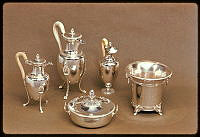
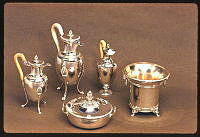
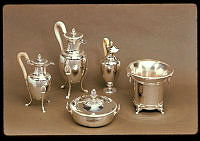
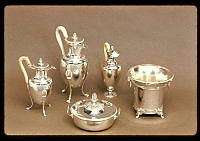
    The coffeepot, hot-water pot, cream pitcher, and vegetable dish are part of the 130-piece silver service President Andrew Jackson purchased from Baron de Tyull, the Russian minister to the United States, in 1833. The service was created by renowned Parisian silversmith Martin-Guillaume Biennais between 1809 and 1819. The wine cooler was created by Jean Baptiste-Claude Odiot and was purchased during the James Monroe administration. The wine cooler was created circa 1798 and 1809. The pitchers and wine cooler all feature the engraving, "President's House."
  • Jackson Silver and Wine Cooler, White House Collection
    Martin-Guillaume Biennais
    Jean Baptiste-Claude Odiot
    silver
    cooler
    White House Collection
    dishes
    serveware
    tableware
    The coffeepot, hot-water pot, cream pitcher, and vegetable dish are part of the 130-piece silver service President Andrew Jackson purchased from Baron de Tyull, the Russian minister to the United States, in 1833. The service was created by renowned Parisian silversmith Martin-Guillaume Biennais between 1809 and 1819. The wine cooler was created by Jean Baptiste-Claude Odiot and was purchased during the James Monroe administration. The wine cooler was created circa 1798 and 1809. The pitchers and wine cooler all feature the engraving, "President's House."
  • Jackson Silver and Wine Cooler, White House Collection
    Martin-Guillaume Biennais
    Jean Baptiste-Claude Odiot
    silver
    cooler
    White House Collection
    dishes
    serveware
    tableware
    The coffeepot, hot-water pot, cream pitcher, and vegetable dish are part of the 130-piece silver service President Andrew Jackson purchased from Baron de Tyull, the Russian minister to the United States, in 1833. The service was created by renowned Parisian silversmith Martin-Guillaume Biennais between 1809 and 1819. The wine cooler was created by Jean Baptiste-Claude Odiot and was purchased during the James Monroe administration. The wine cooler was created circa 1798 and 1809. The pitchers and wine cooler all feature the engraving, "President's House."
  • Silver Water Pitcher, White House Collection
    G.C. Allen
    silver
    serveware
    White House Collection
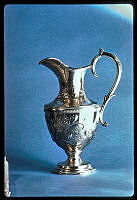
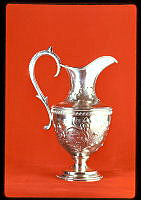
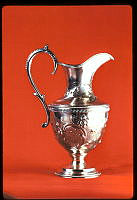
    This silver water pitcher was made by G.C. Allen of New York in 1858 and belonged to President Martin Van Buren. The pitcher is decorated with the flowers and scrolls of the early Victorian era and is engraved with "Martin Van Buren." Benjamin F. Butler, Van Buren's former law partner and attorney general of the United States, bequeathed funds to Van Buren to purchase three pieces of silver which included this pitcher, as well as another pitcher and an ice cream bowl, after his presidency. George F. Mobley photographed the pitcher in 1962, during the John F. Kennedy administration.
  • Silver Water Pitcher, White House Collection
    G.C. Allen
    silver
    serveware
    White House Collection
    This silver water pitcher was made by G.C. Allen of New York in 1858 and belonged to President Martin Van Buren. The pitcher is decorated with the flowers and scrolls of the early Victorian era and is engraved with "Martin Van Buren." Benjamin F. Butler, Van Buren's former law partner and attorney general of the United States, bequeathed funds to Van Buren to purchase three pieces of silver which included this pitcher, as well as another pitcher and an ice cream bowl, after his presidency. George F. Mobley photographed the pitcher in 1962, during the John F. Kennedy administration.
  • Jackson Silver and Wine Cooler, White House Collection
    Martin-Guillaume Biennais
    Jean Baptiste-Claude Odiot
    silver
    cooler
    White House Collection
    dishes
    serveware
    tableware
    The coffeepot, hot-water pot, cream pitcher, and vegetable dish are part of the 130-piece silver service President Andrew Jackson purchased from Baron de Tyull, the Russian minister to the United States, in 1833. The service was created by renowned Parisian silversmith Martin-Guillaume Biennais between 1809 and 1819. The wine cooler was created by Jean Baptiste-Claude Odiot and was purchased during the James Monroe administration. The wine cooler was created circa 1798 and 1809. The pitchers and wine cooler all feature the engraving, "President's House."
  • Silver Water Pitcher, White House Collection
    G.C. Allen
    silver
    serveware
    White House Collection
    This silver water pitcher was made by G.C. Allen of New York in 1858 and belonged to President Martin Van Buren. The pitcher is decorated with the flowers and scrolls of the early Victorian era and is engraved with "Martin Van Buren." Benjamin F. Butler, Van Buren's former law partner and attorney general of the United States, bequeathed funds to Van Buren to purchase three pieces of silver which included this pitcher, as well as another pitcher and an ice cream bowl, after his presidency. George F. Mobley photographed the pitcher in 1962, during the John F. Kennedy administration.
  • George Washington, White House Collection
    Gilbert Stuart
    portraits
    White House Collection
    painting
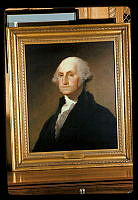
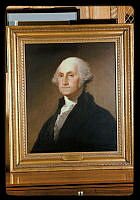
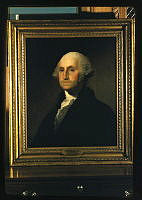
    This oil on canvas portrait of President George Washington was painted by Gilbert Stuart around 1805, six years after the President’s death. This item was a gift of Mr. and Mrs. Charles Payson in memory of Pvt. Daniel Carroll Payson. Washington served as the Commander-in-Chief of the Continental Army during the American Revolution. He served as president from April 30, 1789 until March 4, 1797. The portrait was displayed in the Cabinet Room during the John F. Kennedy administration. Bates Littlehales photographed the portrait in May 1962 in the frame that housed the portrait at the time.
  • George Washington, White House Collection
    Gilbert Stuart
    portraits
    White House Collection
    painting
    This oil on canvas portrait of President George Washington was painted by Gilbert Stuart around 1805, six years after the President’s death. This item was a gift of Mr. and Mrs. Charles Payson in memory of Pvt. Daniel Carroll Payson. Washington served as the Commander-in-Chief of the Continental Army during the American Revolution. He served as president from April 30, 1789 until March 4, 1797. The portrait was displayed in the Cabinet Room during the John F. Kennedy administration. Bates Littlehales photographed the portrait in May 1962 in the frame that housed the portrait at the time.
  • George Washington, White House Collection
    Gilbert Stuart
    portraits
    White House Collection
    painting
    This oil on canvas portrait of President George Washington was painted by Gilbert Stuart around 1805, six years after the President’s death. This item was a gift of Mr. and Mrs. Charles Payson in memory of Pvt. Daniel Carroll Payson. Washington served as the Commander-in-Chief of the Continental Army during the American Revolution. He served as president from April 30, 1789 until March 4, 1797. The portrait was displayed in the Cabinet Room during the John F. Kennedy administration. Bates Littlehales photographed the portrait in May 1962 in the frame that housed the portrait at the time.
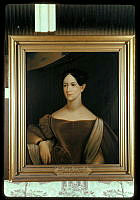
  • Sarah York Jackson, White House Collection
    Mayna Treanor Avent
    portraits
    White House Collection
    painting
    This portrait is of Sarah York Jackson, the wife of President Andrew Jackson's adopted son. Mrs. Jackson assisted Emily Tennessee Donelson, niece of President Jackson and his deceased wife Rachel Jackson, with her duties as White House hostess. Bates Littlehales photographed this portrait in May 1962 in the frame that housed the portrait around the John F. Kennedy administration.