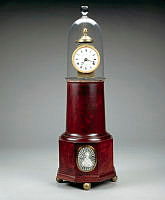
• Lighthouse Clock, White House Collection
    Simon Willard & Son
    clocks
    White House Collection
    furnishings
    This lighthouse-shaped clock was manufactured by Simon Willard & Son of Roxbury, Massachusetts, who began advertising this style of clock in 1822. This is the only one with a portrait of the Marquis de Lafayette, who was received at the White House in 1824 and 1825 when he returned to the United States on a farewell visit.
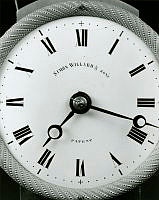
  • Lighthouse Clock, Maker's Mark, White House Collection
    Simon Willard & Son
    clocks
    maker's marks
    White House Collection
    furnishings
    This is the makers mark for a lighthouse-shaped clock manufactured by Simon Willard & Son of Roxbury, Massachusetts. This is the only example of this type of clock with a portrait of the Marquis de Lafayette, who was received at the White House in 1824 and 1825 when he returned to the United States on a farewell visit.
  • Marquis De Lafayette, Blair House Collection
    Unknown
    portraits
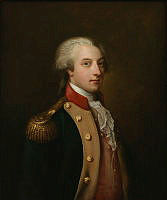
    This is a portrait of the Marquis de Lafayette. The framed piece hangs on the left wall in the Entrance Hall of Blair House and is the first work of art guests observe upon entering the house. Blair House is located across Pennsylvania Avenue from the White House and has been used as the president's guest house since the Franklin D. Roosevelt administration. Visiting diplomats and dignitaries stay at Blair House while on official visits with the White House and is historically where the president-elect and first family reside prior to taking the oath of office.
  • Marquis de Lafayette
    Unknown
    bust
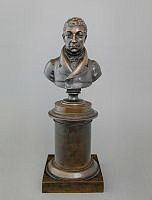
    This bust of the Marquis de Lafayette was given to President James Monroe by the Marquis after his 1824-1825 visit to America. A French aristocrat, Lafayette is renowned for his allegiance with the United States during the American Revolutionary War and his friendships with George Washington, Thomas Jefferson, and Alexander Hamilton, among others. Lafayette's 1824-1825 visits to the White House and to Washington, D.C. were among the highlights of his triumphal tour of the United States, as people honored the last surviving French general of the Revolutionary War and one of the last remaining living links to the Revolutionary Era.

  • Marie Joseph Paul Yves Roch Gilbert de Motier, Marquis de Lafayette, White House Collection
    Unknown
    sculpture
    likeness
    busts
    American Revolution
    White House Collection
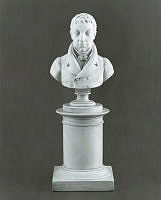
    This plaster bust by an unknown artist is of the Marquis de Lafayette around 1930. A French aristocrat, Lafayette is renowned for his allegiance with the United States during the American Revolutionary War and his friendships with George Washington, Thomas Jefferson, and Alexander Hamilton, among others. Lafayette's 1824-1825 visits to the White House and to Washington, D.C. were among the highlights of his triumphal tour of the United States, as people honored the last surviving French general of the Revolutionary War and one of the last remaining living links to the Revolutionary Era.
  • Marie Joseph Paul Yves Roch Gilbert du Motier, Marquis de Lafayette, White House Collection
    Unknown
    medallions
    likeness
    American Revolution
    White House Collection
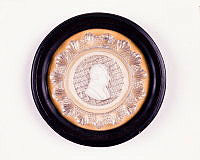
    This glass and sulphide medallion of the Marquis de Lafayette was done by an unknown artist around 1850. A French aristocrat, Lafayette is renowned for his allegiance with the United States during the American Revolutionary War and his friendships with George Washington, Thomas Jefferson, and Alexander Hamilton, among others. Lafayette's 1824-1825 visits to the White House and to Washington, D.C. were among the highlights of his triumphal tour of the United States, as people honored the last surviving French general of the Revolutionary War and one of the last remaining living links to the Revolutionary Era.
  • Marie Joseph Paul Yves Roch Gilbert du Motier, Marquis de Lafayette, White House Collection
    Unknown
    portraits
    likeness
    American Revolution
    White House Collection
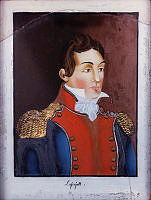
    This oil on glass portrait of the Marquis de Lafayette was done by an unknown artist in the early 19th century. A French aristocrat, Lafayette is renowned for his allegiance with the United States during the American Revolutionary War and his friendships with George Washington, Thomas Jefferson, and Alexander Hamilton, among others. His 1824-1825 visits to the White House and to Washington, D.C. were among the highlights of his triumphal tour of the United States, as people honored the last surviving French general of the Revolutionary War and one of the last remaining living links to the Revolutionary Era.
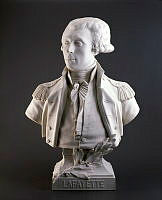
  • Marie Joseph Paul Yves Roch Gilbert du Motier, Marquis de Lafayette, White House Collection
    National Porcelain Factory of Sèvres
    sculpture
    likeness
    busts
    American Revolution
    White House Collection
    This bust of the Marquis de Lafayette was created at the National Porcelain Factory of Sèvres after the work of sculptor Jean Antoine Houdon. Houdon was renowned for his busts of famous politicians of the time. This bust is made of unglazed porcelain and rests atop a long, dark, marble column. The factory was established in 1738 and became the royal factory in 1759. It remains closely tied to the French state today and is run by the Ministry of Culture. A French aristocrat, Lafayette is renowned for his allegiance with the United States during the American Revolutionary War and his friendships with George Washington, Thomas Jefferson, and Alexander Hamilton, among others. Lafayette returned to France until an 1824-1825 visit to the United States. His stops at the White House and Washington, D.C. were among the highlights of his triumphal tour of the country, as people honored the last surviving French general of the Revolutionary War and one of the last remaining living links to the Revolutionary Era.