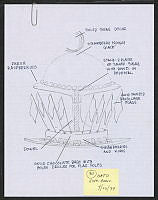
• Sketch of Fresh Fruit Bavarian Dessert, State Dinner for Sweden
    Roland Mesnier
    food & drink
    drawings
    State Dinner
    State Visit
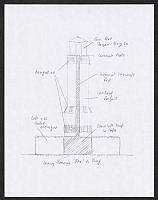
    This is a sketch by White House Executive Pastry Chef Roland Mesnier specifying each part of a fresh fruit Bavarian dessert that he created for a State Dinner in honor of Carl XVI Gustaf, King of Sweden, and Queen Silvia on April 11, 1988. President Ronald Reagan and First Lady Nancy Reagan hosted the King and Queen of Sweden for the first night of their United States tour. Chef Mesnier took inspiration for this dessert from the many fountains in Stockholm, Sweden. On top of the white chocolate fountain was a cantaloupe encased apricot mousse and nougat barquettes filled with raspberry and kiwi sorbets. The dolphins at the base spouted green pulled sugar into white chocolate basins nestled between piles of raspberries. The dessert was accompanied by petit four trays full of butterfly cookies, chocolate truffles, and Florentine squares. This drawing is part of a personal collection belonging to former White House Executive Pastry Chef Roland Mesnier. Chef Mesnier created elaborate desserts for the White House from 1980 to 2004.
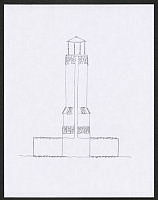
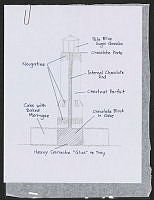
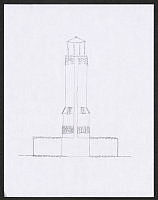
  • Sketch for "A Tribute to Bologna" Dessert, State Dinner for Italy
    Roland Mesnier
    food & drink
    State Visit
    State Dinner
    drawings
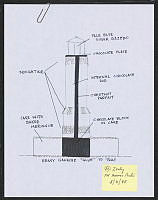
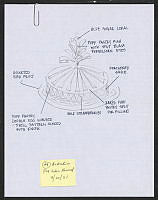
    This is a diagram by White House Executive Pastry Chef Roland Mesnier specifying each part of a brioche cake created for a State Dinner honoring President of the Council of Ministers Romano Prodi of the Italian Republic, (more commonly known as the prime minister of Italy) hosted by President Bill Clinton and First Lady Hillary Clinton on May 6, 1998. Chef Mesnier visited the Italian Embassy to get inspiration for the dessert. Upon learning Prime Minister Prodi was originally from Bologna, Chef Mesnier was inspired by the medieval towers of the city and the use of peaches and chestnuts in desserts from that region of Italy. Additionally, Chef Mesnier was inspired by Italian cakes that are soaked in liqueur and filled with custard cream. The medieval tower inspired dessert was made with a brioche cake soaked in Amaretto syrup, filled with vanilla custard and fresh peach slices, and covered in honey meringue. Accompanying the cake included a chestnut parfait, chocolate and caramel sauces, and a petit four platter of traditional Italian treats featuring sfogliatelle, zepole, and amaretti. The medieval tower was made of chestnut ice cream and decorated with nougat pieces and a sugar blue gazebo on top. Like many of his other desserts, Chef Mesnier designed the tower to have the gazebo still standing once all the ice cream had been eaten. At the end of the night, Chef Mesnier was told Prime Minster Prodi was very touched to see the tower from his birthplace recreated. This drawing is part of a personal collection belonging to former White House Executive Pastry Chef Roland Mesnier. Chef Mesnier created elaborate desserts for the White House from 1980 to 2004.
  • Sketch of Pistachio Marquise with Fresh Raspberries for UK State Dinner
    Roland Mesnier
    food & drink
    State Visit
    State Dinner
    drawings
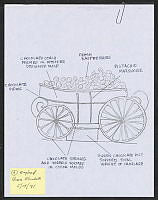
    This is a sketch by White House Executive Pastry Chef Roland Mesnier specifying each part of a chocolate carriage dessert designed for a State Dinner in honor of Queen Elizabeth II of Great Britain and Prince Philip, the Duke of Edinburgh on May 14, 1991, hosted by President George H. W. Bush and First Lady Barbara Bush. Chef Mesnier was ordered to “go all out” when designing the dessert. He previously served the British royals while working as a pastry chef at the Savoy Hotel in London, as the pastry chef to the governor of Bermuda, and other British visits to the White House. The chocolate carriage was filled with pistachio marquise, mousse, crunchy meringue and nougat. Raspberries topped the carriage to look like it was filled them. The chocolate carriage sat on a marzipan “cobblestone,” to create a fairy tale like dessert. The chocolate carriage mold was first carved from wood, then the wooden mold was used to create a silicone mold, and finally the silicone mold was used to mold the chocolate shell of the carriage. The wheels were created similarly, with wooden molds pressed into cocoa powder before chocolate was poured into the impressions. The carriage was also designed to remain standing if someone ate the wheels. This drawing is part of a personal collection belonging to former White House Executive Pastry Chef Roland Mesnier. Chef Mesnier created elaborate desserts for the White House from 1980 to 2004.
  • Sketch of Strawberry Nougat Glacé Dessert, NATO Anniversary Dinner
    Roland Mesnier
    receptions
    food & drink
    drawings
    meals
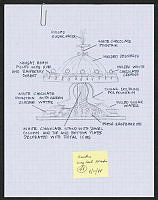
    This is a sketch by White House Executive Pastry Chef Roland Mesnier specifying each part of a glacé dessert designed for a dinner commemorating the 50th anniversary of the signing of the North Atlantic Treaty Organization (NATO) on April 23, 1999. The 50th anniversary dinner was part of a two-day event in Washington, D.C. and hosted by President Bill Clinton and First Lady Hillary Rodham Clinton in the East Room of the White House. The dessert features a dome of strawberry nougat glacé on a blue sugar stand, which was then placed upon solid dark chocolate bases. Holes were placed in the chocolate at an angle to place flags of each NATO nation around the base. The flags were hand painted on pastillage and took several weeks to complete. The dessert was garnished with strawberries and kiwis and served with Champagne sabayon, chocolate globe truffles, and passion fruit tuiles. For a photograph of the dessert, see 1116607. This drawing is part of a personal collection belonging to former White House Executive Pastry Chef Roland Mesnier. Chef Mesnier created elaborate desserts for the White House from 1980 to 2004.
  • Sketch for "A Tribute to Bologna" Dessert, State Dinner for Italy
    Roland Mesnier
    food & drink
    State Visit
    State Dinner
    drawings
    This is a diagram by White House Executive Pastry Chef Roland Mesnier specifying each part of a brioche cake created for a State Dinner honoring President of the Council of Ministers Romano Prodi of the Italian Republic, (more commonly known as the prime minister of Italy) hosted by President Bill Clinton and First Lady Hillary Clinton on May 6, 1998. Chef Mesnier visited the Italian Embassy to get inspiration for the dessert. Upon learning Prime Minister Prodi was originally from Bologna, Chef Mesnier was inspired by the medieval towers of the city and the use of peaches and chestnuts in desserts from that region of Italy. Additionally, Chef Mesnier was inspired by Italian cakes that are soaked in liqueur and filled with custard cream. The medieval tower inspired dessert was made with a brioche cake soaked in Amaretto syrup, filled with vanilla custard and fresh peach slices, and covered in honey meringue. Accompanying the cake included a chestnut parfait, chocolate and caramel sauces, and a petit four platter of traditional Italian treats featuring sfogliatelle, zepole, and amaretti. The medieval tower was made of chestnut ice cream and decorated with nougat pieces and a sugar blue gazebo on top. Like many of his other desserts, Chef Mesnier designed the tower to have the gazebo still standing once all the ice cream had been eaten. At the end of the night, Chef Mesnier was told Prime Minster Prodi was very touched to see the tower from his birthplace recreated. This drawing is part of a personal collection belonging to former White House Executive Pastry Chef Roland Mesnier. Chef Mesnier created elaborate desserts for the White House from 1980 to 2004.
  • Sketch for "A Tribute to Bologna" Dessert, State Dinner for Italy
    Roland Mesnier
    food & drink
    State Visit
    State Dinner
    drawings
    This is a diagram by White House Executive Pastry Chef Roland Mesnier specifying each part of a brioche cake created for a State Dinner honoring President of the Council of Ministers Romano Prodi of the Italian Republic, (more commonly known as the prime minister of Italy) hosted by President Bill Clinton and First Lady Hillary Clinton on May 6, 1998. Chef Mesnier visited the Italian Embassy to get inspiration for the dessert. Upon learning Prime Minister Prodi was originally from Bologna, Chef Mesnier was inspired by the medieval towers of the city and the use of peaches and chestnuts in desserts from that region of Italy. Additionally, Chef Mesnier was inspired by Italian cakes that are soaked in liqueur and filled with custard cream. The medieval tower inspired dessert was made with a brioche cake soaked in Amaretto syrup, filled with vanilla custard and fresh peach slices, and covered in honey meringue. Accompanying the cake included a chestnut parfait, chocolate and caramel sauces, and a petit four platter of traditional Italian treats featuring sfogliatelle, zepole, and amaretti. The medieval tower was made of chestnut ice cream and decorated with nougat pieces and a sugar blue gazebo on top. Like many of his other desserts, Chef Mesnier designed the tower to have the gazebo still standing once all the ice cream had been eaten. At the end of the night, Chef Mesnier was told Prime Minster Prodi was very touched to see the tower from his birthplace recreated. This drawing is part of a personal collection belonging to former White House Executive Pastry Chef Roland Mesnier. Chef Mesnier created elaborate desserts for the White House from 1980 to 2004.
  • Sketch for "A Tribute to Bologna" Dessert, State Dinner for Italy
    Roland Mesnier
    food & drink
    State Visit
    State Dinner
    drawings
    This is a diagram by White House Executive Pastry Chef Roland Mesnier specifying each part of a brioche cake created for a State Dinner honoring President of the Council of Ministers Romano Prodi of the Italian Republic, (more commonly known as the prime minister of Italy) hosted by President Bill Clinton and First Lady Hillary Clinton on May 6, 1998. Chef Mesnier visited the Italian Embassy to get inspiration for the dessert. Upon learning Prime Minister Prodi was originally from Bologna, Chef Mesnier was inspired by the medieval towers of the city and the use of peaches and chestnuts in desserts from that region of Italy. Additionally, Chef Mesnier was inspired by Italian cakes that are soaked in liqueur and filled with custard cream. The medieval tower inspired dessert was made with a brioche cake soaked in Amaretto syrup, filled with vanilla custard and fresh peach slices, and covered in honey meringue. Accompanying the cake included a chestnut parfait, chocolate and caramel sauces, and a petit four platter of traditional Italian treats featuring sfogliatelle, zepole, and amaretti. The medieval tower was made of chestnut ice cream and decorated with nougat pieces and a sugar blue gazebo on top. Like many of his other desserts, Chef Mesnier designed the tower to have the gazebo still standing once all the ice cream had been eaten. At the end of the night, Chef Mesnier was told Prime Minster Prodi was very touched to see the tower from his birthplace recreated. This drawing is part of a personal collection belonging to former White House Executive Pastry Chef Roland Mesnier. Chef Mesnier created elaborate desserts for the White House from 1980 to 2004.
  • Sketch for "A Tribute to Bologna" Dessert, State Dinner for Italy
    Roland Mesnier
    food & drink
    State Visit
    State Dinner
    drawings
    This is a diagram by White House Executive Pastry Chef Roland Mesnier specifying each part of a brioche cake created for a State Dinner honoring President of the Council of Ministers Romano Prodi of the Italian Republic, (more commonly known as the prime minister of Italy) hosted by President Bill Clinton and First Lady Hillary Clinton on May 6, 1998. Chef Mesnier visited the Italian Embassy to get inspiration for the dessert. Upon learning Prime Minister Prodi was originally from Bologna, Chef Mesnier was inspired by the medieval towers of the city and the use of peaches and chestnuts in desserts from that region of Italy. Additionally, Chef Mesnier was inspired by Italian cakes that are soaked in liqueur and filled with custard cream. The medieval tower inspired dessert was made with a brioche cake soaked in Amaretto syrup, filled with vanilla custard and fresh peach slices, and covered in honey meringue. Accompanying the cake included a chestnut parfait, chocolate and caramel sauces, and a petit four platter of traditional Italian treats featuring sfogliatelle, zepole, and amaretti. The medieval tower was made of chestnut ice cream and decorated with nougat pieces and a sugar blue gazebo on top. Like many of his other desserts, Chef Mesnier designed the tower to have the gazebo still standing once all the ice cream had been eaten. At the end of the night, Chef Mesnier was told Prime Minster Prodi was very touched to see the tower from his birthplace recreated. This drawing is part of a personal collection belonging to former White House Executive Pastry Chef Roland Mesnier. Chef Mesnier created elaborate desserts for the White House from 1980 to 2004.
  • Sketch of Red Fruit and Ginger Cream Dessert, Luncheon for Australia
    Roland Mesnier
    meals
    drawings
    food & drink
    This is a sketch by White House Executive Pastry Chef Roland Mesnier specifying each part of a fruit and cream puff pastry dessert that he created for a luncheon honoring Prime Minister John Howard of Australia hosted by President George W. Bush on September 10, 2001. The dessert was inspired by Australia and featured an oversized scallop shell made of puff pastry and filled with a light ginger custard cream. The cream is mixed with red currants, raspberries, strawberries, and pomegranate seeds. The puff pastry was cut at an angle with the strawberries placed to make the scallop appear to be held open by them. Lemon sauce, blue sugar coral, and puff pastry fish decorate the plate and the dessert. This drawing is part of a personal collection belonging to former White House Executive Pastry Chef Roland Mesnier. Chef Mesnier created elaborate desserts for the White House from 1980 to 2004.
  • Sketch of Mango Coconut Lei Dessert, State Dinner for the Philippines
    Roland Mesnier
    food & drink
    State Visit
    State Dinner
    drawings
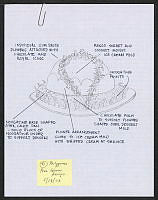
    This is a sketch by White House Executive Pastry Chef Roland Mesnier specifying each part of an ice cream and baked pineapple dessert that he created for a State Dinner for the President Gloria Macapagal-Arroyo of the Philippines and her husband, Jose Miguel T. Arroyo, hosted by President George W. Bush and First Lady Laura Welch Bush on May 19, 2003. The dessert was designed to represent the friendship between the two countries through an edible lei draped on mango ice cream and coconut mousse molds, that was then displayed on caramel and almond nougat stands. The lei was created with sugar flowers glued to a chocolate base. In addition to the ice cream and mousse, a baked pineapple topped with crunchy sesame streusel and honey meringue was served. The flavors were chosen as a nod to Philippine cuisine. This drawing is part of a personal collection belonging to former White House Executive Pastry Chef Roland Mesnier. Chef Mesnier created elaborate desserts for the White House from 1980 to 2004.
  • Preliminary Sketch for the 2006 White House Gingerbread House
    Shealah Craighead
    winter holidays
    gingerbread
    food & drink
    drawings
    decorations
    Christmas
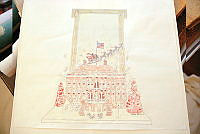
    This preliminary sketch by White House Calligrapher Debra Brown shows a design idea for the 2006 White House Gingerbread House. The "Red and White" Gingerbread House was designed to complement the holiday theme selected by First Lady Laura Welch Bush. Former White House Executive Pastry Chef Roland Mesnier, who retired in 2004, returned at Mrs. Bush's request to oversee the creation of the gingerbread house. Mesnier and his team decorated the gingerbread White House with more than 850 snowflakes and red bows made from royal icing.
  • President Theodore Roosevelt Practices Jui-jitsu
    John Hutton
    East Room
    State Floor
    White House Guests
    sports
    drawings
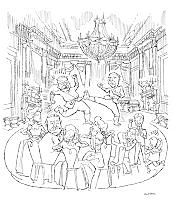
    This illustration shows President Theodore Roosevelt learning jui-jitsu from Yamashita Yoshiaki in the East Room. The spectators include future president William H. Taft, Roosevelt's sons, Theodore, Kermit, Quentin, and Archibald, and three women: most likely Roosevelt's wife, Edith, and daughters Alice and Ethel. Around 1905, the president invited the celebrated martial artist and instructor to the White House to provide a demonstration. The president himself took part in the demonstration in the East Room. This artistic interpretation was created by John Hutton for the White House Historical Association. Hutton's whimsical illustrations were featured in his book "How to Draw the Presidents," published by the White House Historical Association.
  • The National Game, Three "Outs" and One "Run," Abraham Winning the Ball
    Currier & Ives
    Louis Mauer
    sports
    likeness
    caricature
    campaigns
    Congress
    drawings
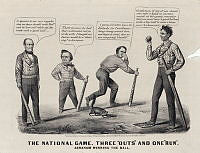
    This satirical cartoon was submitted for copyright shortly before the presidential election of 1860. The cartoon depicts the political contest as a baseball game. Abraham Lincoln stands at home base on the right side of the image, advising his opponents, from left to right: former Senator John Bell, Senator Stephen A. Douglas, and John C. Breckinridge, who was then Vice President of the United States under President James Buchanan. The text on the men's bats and belts provides clues about their political platforms. Instead of a baseball bat, Lincoln holds a wooden rail labeled "Equal Rights and Free Territory." A skunk stands near the other candidates, signifying that they have been "skunk'd," or overwhelmingly defeated.
  • Garden Tour Program, Carter Administration
    White House Calligraphy Office
    program
    South Grounds
    drawings & plans
    maps
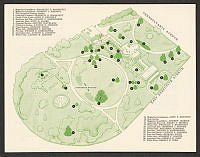
    This is the unfolded internal page of a program created for a public White House gardens and grounds tour during the administration of President Jimmy Carter (1977-1981). The program includes a greeting from First Lady Rosalynn Carter, a map of the South Grounds including sites of presidential tree plantings, and information about the history of the gardens and their uses. Before the late-19th century, private citizens wandered the White House South Grounds like a public park, but by the Calvin Coolidge administration (1923-1929), the grounds were closed to the public due to security and privacy concerns. However, just as First Lady Jacqueline Kennedy opened the White House to the public with controlled public tours, in 1972 First Lady Pat Nixon established the tradition of hosting White House garden tours. During the anticipated event, which expanded to being held two weekends a year, lucky members of the public have a chance to view the first family's private gardens. To view the complete program, see 1127095. This program is part of a personal collection belonging to former White House Executive Chef Henry Haller. Haller served five first families and their distinguished guests as executive chef of the White House from 1966-1987.
  • Front View of the President's House, White House Collection
    George Catlin
    White House
    north view
    White House Collection
    drawings
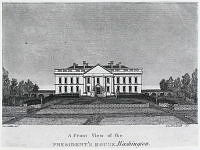
    This black and white illustration by George Catlin shows a north view of the White House. It was drawn during James Monroe's presidency (1817-1825).
  • The Outgoing and Incoming Presidents Leaving the White House, at 10:30 AM, for the Capitol (back), White House Collection
    inaugurations
    drawings
    White House Collection
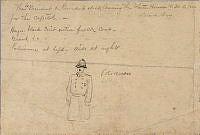
    This image is the back of the pencil sketch by Albert Berghaus depicting Inauguration Day 1877. Berghaus was a Reconstruction-era American illustrator who worked for Frank Leslie's Weekly. Berghaus' original works are extremely rare and few are in private collections. The back side of the sketch contains an inscription explaining the contents of the scene as well as a separate sketch of a police officer matching the front, where a line of police officers stands next to the open carriage. See image 8771 for the front side of the sketch.

  • The Outgoing and Ingoing Presidents Leaving the White House, at 10:30 AM, for the Capitol (front), White House Collection
    transportation
    inaugurations
    drawings
    North Portico
    North Drive
    White House Collection
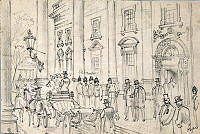
    This pencil sketch by Albert Berghaus is of Inauguration Day 1877. Outgoing President Ulysses S. Grant and President-Elect Rutherford B. Hayes leave the White House for the ceremony at the Capitol. Berghaus was a Reconstruction-era American illustrator who worked for Frank Leslie's Weekly. Berghaus' original works are extremely rare and few are in private collections. This sketch appears to be preliminary, with details such as the detailed stonework over the entrance to the North Portico only partially completed, as though Berghaus intended to use it for a larger work or finish the sketch later. See image 8772 to see the reverse side sketch and inscription.
  • Unidentified Man, White House Collection
    portraits
    drawings
    White House Collection
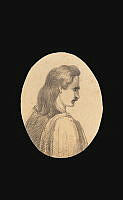
    This portrait of an unidentified man was a pencil sketch attributed to Benjamin Henry Latrobe. Latrobe is best known as the architect who designed the U.S. Capitol, St. John's Church and the Decatur House in Lafayette Square, the White House East and West Terraces, and the Madison state rooms, and was the chief engineer for the U.S. Navy.
  • Hungry Office Seekers, White House Collection
    political cartoons
    lobbyists
    drawings
    Washington, D.C.
    White House Collection
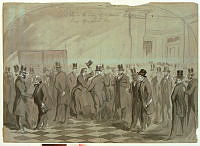
    This drawing is by Thomas Nast, a pictorial reporter with the New York Illustrated News who would later go on to work as a political cartoonist for Harper's Weekly. In the drawing, a large group of men congregate in the lobby of the famous Willard Hotel in Washington, D.C. on March 6, 1861, just two days after President Abraham Lincoln's first inauguration. Notable among the men is Horace Greeley, the editor of the New York Tribune, who stands conversing with another man on the right. The German-born Nast is widely considered to be one of the premiere political cartoonists in American history, famous for his early 1870s crusade against William Marcy "Boss" Tweed in New York City.
  • To the Genius of Franklin, White House Collection
    Jean-Honoré Fragonard
    drawings
    White House Collection
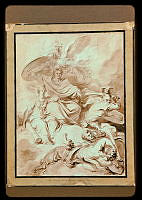
    This pencil drawing by French painter Jean-Honoré Fragonard was completed circa 1778. Fragonard completed the drawing while Benjamin Franklin was serving as a United States envoy in France. Franklin was a renowned author, inventor, and philosopher who was also one of the signers of the Declaration of Independence and the Constitution. The Franklin figure is seated and wearing Roman-style robes and a laurel wreath, with female figures surrounding him. Male figures, in similar classical attire, fight before him. The sketch was made quickly while Franklin was visiting the Louvre. From the drawing, an etching and aquatint were created by Jean-Honoré Fragonard's sister-in-law Marguerite Gérard. This was the first major acquisition by the White House Fine Arts Committee during the John F. Kennedy administration. Bates Littlehales photographed the drawing in March 1962, also during the Kennedy administration.
  • James Hoban White House Competition Design
    James Hoban
    drawings & plans
    White House
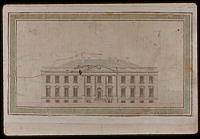
    This plan was drawn by James Hoban circa his 1793-1794 designs for the White House. Hoban, an Irish-born architect, won the competition to design the President's House. The competition was announced by then-Secretary of State Thomas Jefferson and the prize for the winner was $500 or a medal of equal value. This drawing captures an initial plan for the North Front of the White House. Winfield Parks photographed this plan in 1962.
  • James Hoban White House Competition Design
    James Hoban
    drawings & plans
    White House
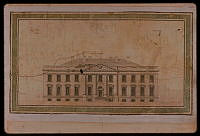
    This plan was drawn by James Hoban circa his 1793-1794 designs for the White House. Hoban, an Irish-born architect, won the competition to design the President's House. The competition was announced by then-Secretary of State Thomas Jefferson and the prize for the winner was $500 or a medal of equal value. This drawing captures an initial plan for the North Front of the White House. Winfield Parks photographed this plan in 1962.
  • James Hoban White House Competition Design
    James Hoban
    drawings & plans
    White House
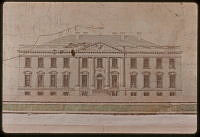
    This plan was drawn by James Hoban circa his 1793-1794 designs for the White House. Hoban, an Irish-born architect, won the competition to design the President's House. The competition was announced by then-Secretary of State Thomas Jefferson and the prize for the winner was $500 or a medal of equal value. This drawing captures an initial plan for the North Front of the White House. Winfield Parks photographed this plan in 1962.
  • First Stop, the Stone Yard at Tiber Creek
    Dahl Taylor 
    drawings & plans 
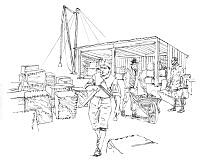
    This drawing by Dahl Taylor is of the Stone Yard at Tiber Creek. Here the stones were graded for quality, and selected for the walls or ornamental carvings. It is one in a series of eleven drawings illustrating the journey of the stones used to build the White House from Aquia Quarry to the building site.
  • At the Building Site, Finishing the Stone
    Dahl Taylor 
    drawings & plans 
    This drawing by Dahl Taylor is of a stonemason carving a piece of exterior molding at the building site of the White House. It is one in a series of eleven drawings illustrating the journey of the stones used to build the White House from Aquia Quarry to the building site.