• Postcard of the Harry S. Truman in Uniform
    Unknown
    military
    World War I
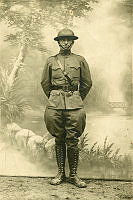
    This postcard studio portrait photo of Harry S. Truman wearing his uniform and helmet was taken in France during World War I. Noted on the reverse of the postcard: "Given to John A. Hatfield in France in 1918 - returned to Harry S. Truman in January, 1962." Truman enlisted for service with the National Guard in 1905. During World War I, Truman served as a captain in the Field Artillery, wearing the standard olive drab, M1910 service uniform: breeches that flared out at the thigh, a single-breasted coat with four front pockets, tall lace-up boots, and a helmet. As vice president, Truman became president when President Franklin D. Roosevelt died during his fourth term in office in 1945. He was elected president in his own right during the 1948 election, serving from January 20, 1949 to January 20, 1953. During his second term, Truman was the target of an assassination attempt while living in Blair House during a major White House renovation. He served in the Senate prior to his years in the White House.
  • Woodrow Wilson and Prize Rooster Winners
    Harris & Ewing
    Alabama
    White House Guests
    World War I
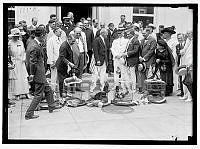
    This photograph is of President Woodrow Wilson with the "Big Four" prize roosters representing the premiers of the victorious powers in World War I outside the main door to the Executive Offices, later known as the West Wing. These roosters were purchased in France and, with a fifth bird (also depicted) that Wilson purchased, would be sold at auction to benefit highway-building in Alabama.
  • President Wilson with Allied Leaders
    Unknown
    World War I
    Head of State
    France
    Presidential Visit
    travel
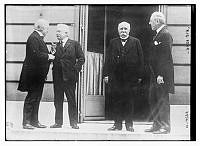
    This photograph shows President Woodrow Wilson with the Prime Ministers of Great Britain, France, and Italy. These World War I leaders were known as the Big Four. Left to right: David Lloyd George (Britain), Vittorio Emanuele Orlando (Italy), Georges Clemenceau (France), and Woodrow Wilson. In 1919 the Big Four met in Paris, France to negotiate the Treaty of Versailles after the end of World War I. This photograph was taken outside the Hotel Crillon in Paris.
  • Woodrow Wilson and Prize Rooster Winners
    Unknown
    World War I
    Alabama
    White House Guests
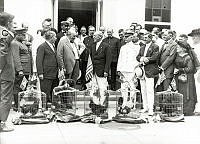
    This photograph is of President Woodrow Wilson with the "Big Four" prize roosters representing the premiers of the victorious powers in World War I outside the main door to the Executive Offices, later known as the West Wing. These roosters were purchased in France and, with a fifth bird (also depicted) that Wilson purchased, would be sold at auction to benefit highway-building in Alabama.
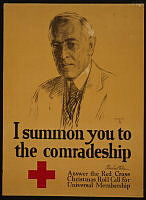
  • President Wilson and His Red Cross Recruitment Poster
    United States Printing and Lithograph Co.
    World War I
    portrait
    This poster features a portrait of President Woodrow Wilson, and recruits Red Cross membership as part of the war effort. The portrait was drawn by Leo Mielziner in 1918. President Wilson was an honorary chairman of the Red Cross during World War I. The Red Cross Christmas Roll Call, held from December 16 to 23, encouraged the public to renew their memberships or join for the first time.
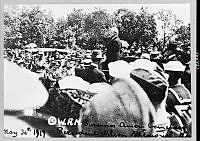
  • President Wilson at Suresnes
    Unknown
    World War I
    This photograph shows President Woodrow Wilson speaking to a crowd at Suresnes American Cemetery and Memorial just outside of Paris, France. President Wilson visited the cemetery with his wife, First Lady Edith Bolling Galt Wilson, on Decoration Day, now Memorial Day, to remember the soldiers who died during the Great War. This visit happened during the peace treaty talks after World War I ended. Suresnes American Cemetery and Memorial holds the graves of over 1,500 American soldiers spanning both world wars.
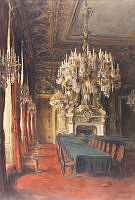
  • The Clock Room, Quai d'Orsay, White House Collection
    Fülöp László
    painting
    World War I
    France
    White House Collection
    This painting was done by Fülöp László (sometimes known as Philip Alexius de Laszló de Lombos). The Quai d'Orsay is the home of the French Ministry of Foreign Affairs. The Clock Room is a large space often used for receptions, and was the site of the 1919 Paris Peace Conference following the end of World War I. László was Hungarian-born but moved to Britain as an adult. He was renowned for his portraits. His subjects included Emperor Franz Joseph I of Austria and Presidents Calvin Coolidge and Theodore Roosevelt.